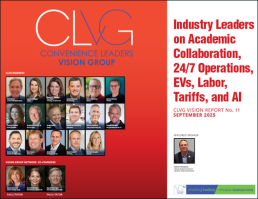
CLVG August 27, 2025 Meeting Transcript
Meeting Facilitator
- Myra Kressner, VGN Co-Founder and CEO Kressner Strategy Group
- Roy Strasburger, VGN Co-Founder, CEO StrasGlobal and President Compliance Safe
CLVG Member Participants:
- Laura Aufleger, President, On Cue
- Annie Gauthier, CFO/Co-CEO, St. Romain Oil
- Joseph Hamza, Chief Operating Officer, Nouria
- Tracey Hughes, CEO, Wallis Co.
- Greg Parker, Executive Chairman, Parker’s Kitchen
- Jonathan Polonsky, CEO, Plaid Pantry
- Darren Rebelez, Chairman, President and CEO, Casey’s General Stores
- Mark Samuels, Executive Vice President of Convenience Retailing, Dash In/The Willis Group
- Joe Sheetz, Executive Vice Chairman, Sheetz
- Keith Slater, Chief Financial Officer, Family Express Corp
Presenter
- Robert Hampton, VGN, Director of Strategic Growth & Initiatives
Guests
- Aditya Soman, VP Fuels, Oxxo
Ally Supporter
- James Hervey, Head of Petro, Verifone
Vision Group Network Founders
- Myra Kressner, CEO Kressner Strategy Group
- Eva Strasburger, President StrasGlobal and CEO Compliance Safe
- Roy Strasburger, CEO StrasGlobal and President Compliance Safe
Meeting:
Myra Kressner:
Welcome everyone. I am Myra Kressner, and on behalf of myself and fellow Vision Group Network co-founders, Eva Strasburger and Roy Strasburger, welcome to this CLVG meeting. This is our 11th virtual meeting since November of 2022.
First, I want to take this opportunity on behalf of all of us to thank James Hervey and Verifone as CLVG’s Ally Supporter. I’m sure all of our members join me in recognizing and appreciating your participation and supporting VGN’s spirit of Sharing Today to Shape Tomorrow. So, thank you, James.
As you know, Tom Kloza was originally scheduled on July 24th to lead a discussion on 2025 petroleum markets. Due to a medical emergency on that day, the meeting was rescheduled for today. And then, unfortunately, a few days ago, Tom had a serious fall that resulted in neck surgery. Fortunately, he is recovering well but could not commit to today’s call.
So, we are taking this opportunity for CLVG to discuss a compelling and important academic partnership initiative that Eva, Roy, and I have been working on for quite a few months together with Robert Hampton, whom I’ll introduce shortly. We think this initiative offers a lot of opportunities with actionable results for CLVG and our other Vision Group Network members as well as the entire convenience industry. And as Monday’s agenda email stated, depending upon time, we’ve also identified several additional hot issues to discuss, from questions about do we keep 24-hour stores, to EV charging, the impact of tariffs, and of course, AI.
But first, some brief housekeeping.
We’ve got our Publication and Antitrust Statement that every member and participant has signed. So, please be sure to follow those antitrust guidelines. [Publication and Antitrust Statement Shown on Screen]
A few other brief reminders. Please use your camera and keep it on as much as possible. Conversely, please keep your audio on mute unless you are speaking so that we can minimize any ambient noise. Please use the raise hand icon or physically just raise your hand for good conversation flow unless you’re clearly in a back-and-forth discussion. If you need to leave the meeting for any reason, you can either write a short note in chat or just leave and return when you’re able. Lastly, and very important for our new members that are on this call, since we want frank and diverse discussion, if anyone wants to make an off-the-record comment, just let us know what you’re about to say or have said is off-the-record.
Before we begin today’s discussion, I would like our two new CLVG members to briefly introduce themselves, and we also have a guest who will also introduce himself. Our new members are Keith Slater with Family Express and Joe Hamza with Nouria. Welcome to you both. Keith, would you introduce yourself?
Keith Slater:
Certainly. Thanks Myra. Appreciate the opportunity. I’m Keith Slater. I’m the chief financial officer with Family Express. I’ve been here about a year and a half or so. Prior to Family Express, I was with MAPCO for seven years, so nice to meet everybody.
Myra Kressner:
Thank you. And Joe Hamza, welcome.
Joe Hamza:
Thank you, Myra. My name is Joe Hamza. I’m the chief operating officer for Nouria. Actually, next week it’ll be my 10th anniversary here. I’ve had the privilege of serving in this role for this long, doesn’t seem that way. Prior to that, I was with Tedeschi Food Shops as head of marketing. And I’m really honored to be part of this group of industry leaders. I look forward to learning from this exceptional community and sharing experiences and contributing to the collective mission of really advancing this industry in our respective businesses. So, thank you.
Myra Kressner:
Thank you, Joe. And just one more introduction. Hal Adams with OXXO is not able to join us today so he has asked Aditya Soman to join as his guest. So, Aditya, would you please introduce yourself?
Aditya Soman:
Thank you so much, Myra. This is Aditya Soman. I am the vice president of fuel for OXXO and Southwest Convenience Stores. I’ve been with OXXO now since the transaction with Delek about eight, nine months ago. And then prior to that I was a partner at a consulting firm called Boston Consulting Group, BCG, where I focused on fuel retail and the oil and gas business and chemicals and things like that. So, I appreciate Hal adding me to this meeting. And I’m thrilled and excited and looking forward to hearing more.
Myra Kressner:
Thank you everyone. Now I would like to introduce Robert Hampton, who is going to take us through our academic partnership initiative. Robert, would you please introduce yourself and what you’re now doing with VGN and then lead us into the discussion and, Roy, you can then lead the rest of the way.
Robert Hampton:
Great, thank you. Myra. I think I know a few of you on the call, but my name is Robert Hampton, and I’ve been in the convenience industry for about 16 years and two tours of duty. First was with Texaco where I managed point-of-sale systems and development for the old Texaco refining and marketing group, which was back in the ’90s so now I’m dating myself a little bit. The second was most recently with Jacksons Food Stores where I was the CIO and VP of innovation for about nine years.
Some of you may have seen me on a few panels at NACS (National Association of Convenience Stores), NRF (National Retail Foundation), and Conexxus. I was the chairman of the Conexxus Board of Advisors. And I’m doing consulting in the retail convenience space now since about the first of the year. Roy, Myra and Eva reached out to me and I’m happy to be partnering with them and helping them with a number of initiatives. Two of them, we’ll talk about here today. So, with that, let me share my screen.
[SIDE 1 Cover Slide] [SLIDE 2– VGN Academic Partnership – Background] As Myra mentioned, we’ve been talking about an academic partnership. And when I first heard of this, I had some experience with it and I think a few of the folks on the call may have as well.
I’m not going to read everything on here, but basically academic institutions can be a great source of out-of-the-box thinking and short-term resources for projects and problem-solving opportunities. I happen to serve on a couple of boards with Texas Tech University where I got my bachelor’s in engineering. I’m on the Computer Science Board, as well as the Dean’s Council. And I’ve floated this idea with them. They’re very interested. I’ve talked many times with the chair of the computer science department, and they’ve agreed to partner with us and help.
And just to cover a few recent examples of partnerships, Conexxus leveraged a hackathon in Germany to develop some APIs (Application Program Interface) and interfaces for the Smart Safe standard, which was very successful. I know Gray Taylor’s been talking quite a bit about that. During my time at Jacksons, we worked closely with Boise State University, and we had a number of senior projects or Capstone projects where we leveraged students. We came up with projects, worked with the AI and ML (machine learning) groups within the computer science department there, and had a number of projects that we did with them. And it was very successful.
Editor’s Note: Smart Safe Standard: A smart safe is a commercial device that follows standards from other organizations, focusing on physical security, payment processing and connectivity.
Workforce Again, as I mentioned earlier, I know a few of the other folks on this call have had successful partnerships. One thing that was a great benefit that came out of the work I did with Jacksons and Boise State is we opened up a pipeline of great students and talented individuals to come into the department. In fact, I believe the number was four out of the five folks that I hired on the BI (Business Intelligence) team came through Boise State through their program. So, it was a great way to introduce students to the industry and to help folks recognize that the convenience industry isn’t just about selling beer and cigarettes at 2 A.M. We’re doing a lot of really cool things. And when I would participate in student events and recruiting events at Boise State, people just didn’t realize that. And once I told them, I’m like, “Hey, we’ve got these projects with the computer science department. We’re doing all these great things with supply chain and analytics,” people became really interested. So again, it’s a way to really articulate that within the academic side and bring some good, fresh talent into the convenient space.
Strategy What we’re going to talk about here today is a framework that Roy, Myra, Eva and I have worked through. We don’t have all the answers. We were looking for some input from you guys. But the proposal is that the Vision Group Network would help facilitate the initial effort to get this off the ground to work with institutions on capstone projects, which is generally a one or two semester project, and also hackathons. And I’ll go into a little bit more detail on both of those, but I’ve got agreement from Texas Tech University to work with us on these two things.
[SLIDE 3 – VGN Academic Partnership – Capstone Project] So, just to level set, academic partnership for a capstone project usually runs an entire semester, sometimes it can be two semesters. And depending on the length and complexity, it can vary in the involvement. Generally, what we found at Jacksons was that we would have weekly meetings with the students and the academic sponsor, they were generally half an hour, sometimes they’d be an hour. Usually, they were more towards an hour starting off. But as the students got going, they were cut down to just half hour, just a check-in and help when needed.
We had the students sign NDAs (non-disclosure agreements) because we had them working with data. One of the big things to keep in mind is you need a really clear requirements document and expectations that you can set with the students and the department. That really helps eliminate any ambiguity and you need clarity about what you’re asking these students to do. And then we had it set up so that the students would present at the end, and we brought in folks from operations or marketing depending on the type of project that the students were working on. And it gave great exposure to the students, it gave great insights to the business units, and it worked out really well with that format.
One of the things we had the students do is sign a perpetual license agreement, irrevocable license agreement, so that any of the code or the intellectual property that they created, we had a license to use however we wanted. We paid the students, I believe it was $500 or $700 for any license of the intellectual property that we used. The students were really happy about that, and it worked out well for us. So, it was kind of a win-win all around.
Again, I ran a number of these. I think we did at least three semesters worthwhile I was at Jacksons and got really good feedback.
[SLIDE 4 – VGN Academic Partnership – Hackathon] Okay. The next one we’ll talk about is a hackathon. And most recently, Texas Tech has been running hackathons in the fall. It’s student-run. They have student organizations that run these. And it was really successful. I think they had about 300 people attend. It was a weekend hackathon in the fall of 2024. It was sponsored by a couple of local companies and went really well. The way they structured it was they gave awards for the most innovative solution, the fastest solution, things like that. And so, the students were excited about it. They really enjoyed doing it. The Association for Computing Machinery is the student organization that was running this, and I’ve been working with their president, and she said it’s been so successful that they want to start a second one and do two of them every year. And so, the one that they have committed to working with us on is for spring of 2026. So, we’ve got a little bit of time for planning and to work with them to get this set up. The nice thing is they handle all the logistics from the space required to do it, the advertising of it with the student body, ordering the food, and all that stuff. They’re just looking for us to help bring ideas, bring problems to solve and have some judges be there. And if we want to involve some of the folks on this call or as a sponsorship or if you guys have got problems and want solutions, this would be a great opportunity.
There are a couple different formats for the hackathon. The one that [Texas] Tech has done recently, they’ve done a weekend one and they’ve done one that was 24 hours, so they’re open to either one of those. But also, we could do one over a month where you start on a weekend and if it’s a little bit larger project or it might take a little bit longer to do, they have it start on a Saturday, you meet the next Saturday, and the following Saturday, and then you present the results. And that one has worked well. Tech hasn’t done any of the month-long ones, but I’ve heard that some of those work really well, as well.
We need some really clear requirements and understanding of what’s needed by the students, and what problems we’re trying to solve. And we may not solve a specific issue, but we may gain a lot of learning from what the students come up with and just the research and the out-of-the-box thinking that they’re going to do to try to solve a problem. So, always keep that in mind. Again, we would have them sign a license agreement for any work that the group decides to take from that. And for the hackathon, generally there’s awards and prizes that we give out.
[SLIDE 5 – VGN Academic Partnership – Next Steps] So, next step is we need advice and thoughts from the folks on this call. What problems do we think we need to solve either within the industry or specific problems moving data around? And Gray Taylor [of Conexxus] likes to talk about this. And I should mention that we’ve talked to Conexxus about this, as well. I’ve had many conversations with Gray, and Gray always likes to say that this industry is lugging around Soviet-era ’80s technology when it comes to interfacing with fuel dispensers and stuff like that. And that’s kind of holding us back from the little ice cream store down the street that can handle transactions on an iPad and check people out in two seconds. We’ve got a lot of reasons why we can’t do that but some of it we can do. And if we put the appropriate resources to bear on solving some of these problems, we might be able to do some things there and really innovate.
So, where can we get the biggest bang for this? We’ve got students and an institution ready and willing to work with us. How can we leverage this for the benefit of the industry and for the benefit of our collective customers and make things better for them? Are there any gaps in doing this on a larger scale? Yes, there would be coordination on doing this. If we get Texas Tech and we can do that for the next couple of years, it’s not to say we can’t involve universities all around the country. The only reason we picked Tech is my association with them. But I know many of you probably have associations with local universities and we can certainly add them into the mix, as well.
And then we might need a little help in input on the formal process. I’ve put together a framework for an intake form, what a project would look like. If one of you wanted to suggest something, we would fill out an intake form, we’d get that to the university and have them partner with us and work to narrow down and really define what it is we’re looking for and anything else that we need to think about.
And sponsorship, of course, is needed to get this up and running — the cost to cover the expense of some of the things, the administration of this, as well as with the hackathon, some of the prizes and other things there. And again, talking about leveraging my relationship right now, Texas Tech has over a thousand computer science students enrolled in the fall of 2025 that just started. And they’ve got 5,700 engineering students that we could certainly leverage if we need to.
So, that’s kind of it in a nutshell. Open for any thoughts, comments, suggestions? Roy, I think maybe you had something you wanted to mention, as well?
Roy Strasburger:
[Slide 6 – Questions/Feedback] Strategy First of all, Robert, thank you for putting the presentation together. As Robert has laid out, and as Myra mentioned at the top, this is an academic program that we’re trying to put together because of two things. One is that the Vision Group Network’s motto is Sharing Today to Shape Tomorrow and we’re trying to develop information and develop ideas to help retailers across the board if we can do that. And the second thing is that, as we all know, technology is moving very, very quickly. As Henry Armour likes to say, “The future is already here. It’s just distributed unevenly.”
We wanted to bring this to the CLVG because you guys are a really smart group of people. And we also want to take this to the other Vision Groups to get their input into it to see if there are ways that we, as an organization, can help facilitate ideas and solutions that will help retailers on an industry-wide basis. I know that’s a very broad remit of trying to help. You can’t help everybody, but we can try to pick out some places where we can focus and can provide some types of solutions to others.
And I know that there are several folks on this call who have done hackathons or worked with universities or have done capstone projects. We wanted to get some input to see whether or not a) this was a viable idea. And if it was, b) what direction did we want to take it in, and how can we flesh this out because we’re still in the starting stage of what we’re doing. Before I start calling on people, does anybody have any ideas or comments or pushback that they would like to discuss?
Eva Strasburger:
If I could just say, you were talking that other people have been involved in this, Roy. We’ve been speaking about this since Greg brought it up at one of the very first meetings, maybe in the second one, about how he used students to follow the EV customer to see what the size of their basket was and how fascinating that information was. So, Greg, thank you for being part of this inspiration.
Greg Parker:
You’re welcome. Yes, I have done this. I’ve done this multiple times. I spoke with Myra and Roy yesterday telling them about how we had done things like this in the past. I’m a big believer. We’ve had some really good outcomes, and we had one really not so great outcome. So, I’m in favor of doing this. As you know, the Coke Council does this. They try to study very important things that are going on in the industry, and they do a deep dive into things like this.
AI When we were talking yesterday, I was saying that it seems to me that the people that are going to win the race of being the most successful business owners in the convenience store space and many other spaces are going to be the people that are most effectively using artificial intelligence. I know that we’ve had one study about this. We talked about this as a group before.
I believe that the world’s going to change, and it’s going to change very quickly with data that people are effectively using, whether it’s for pricing of gas or pricing of store products or what’s going on internally with loyalty, but creating sort of artificial intelligence avatars, however you want to refer to it, that would work with marketing, that would work with fuel, that would work with operations, doing labor templating tools, whatever it is. The people who are going to be the most successful are the ones who are going to be in the forefront of using this. So, I’ve started playing with this myself, and I’m using it quite a bit, just figuring out different riddles.
Strategy But I would think one of the most important things we could do for the industry is to do a capstone project focused on the effective utilization of AI to drive profits and to mitigate expenses. I don’t know if Texas Tech is the right institution. Pretty much most universities are doing things like this right now. It’s not an unusual thing. But I would think we would need to be with people that have strong technology AI departments.
So, my suggestion would be first of all is to figure out what we think the most meaningful study would be, and then for us to shop around and find the right university to work with. Who is doing it? I suggested yesterday to Roy and to Myra that I would think Georgia Tech would be a great school. My soon-to-be daughter-in-law started majoring in AI at Duke in 2016. But the great thing about this for universities is that it creates a pipeline of talent to whoever the companies are that are working with it, so universities like doing this. It certainly is a pay-to-play thing. Like I say, I’ve done, I think, four studies with universities over the years.
Roy Strasburger:
Greg, thanks for that input. One of the things that you mentioned, which I think is spot on, is that we do need to match whatever the project is with the right people to work through it. I absolutely agree 100% with that. And we need to see where we want to go with trying to develop this. Has anybody else had any experience? Joe?
Joe Sheetz:
We’ve done several different things mostly with, well, obviously Penn State, who’s right in our backyard, but probably more recently with Carnegie Mellon since our innovation group is in Pittsburgh, and we have quite a few Carnegie Mellon graduates that work for us.
I would say there’s been little to no luck with things like a hackathon. It’s too quick. You would have to have a very specific [topic]. A lot of it’s like, if it was coding and you wanted to bang something out, that’s great. But I think you tend to get a lot of idea flow and sort of half-baked ideas, but you don’t really get a solution in 24 hours. That’s why we’ve leaned more toward the capstone side and tried to lean more toward the older students. That probably sounds wrong. But we’ve done some across the board, and the output we’ve gotten when it’s more of a group of senior students or graduate students is so much higher level than just a random assortment of undergraduates.
I agree with everything Robert said that you have to be very, very specific about what you are trying to solve. You can’t make it so open-ended. So, if we’re going to do something with AI, I think it has to be very specific. We’re after these things, these efficiencies, these particular labor savings, these particular ways to track and talk to customers or whatever, because otherwise they just kind of go off. The check-ins are very important, too, to make sure they’re not going somewhere that just frankly doesn’t make sense, because you’re sort of renting very large brains that know a lot about technologies that most of us, at least at my age, don’t know about, but they really don’t understand the business at all. And you need both. Everyone wants to run and say, “AI’s going to solve the world.” Well, it’s not unless you can figure out how to tie it into the actual business problems. So, I think this could be well done.
We’ll have to really think hard, though, about what would benefit the industry overall rather than just parts of the industry. Because if you get into technology and you have everybody using different technology providers or having different infrastructures, it may be challenging to come up with that thing that we feel benefits a large group. Not impossible, but I think you’d have to spend a lot of time going through that.
Roy Strasburger:
Those are some great comments, Joe, and I think that’s some great insight regarding the hackathon versus the capstone. It makes a lot of sense in reference to what we’re talking about. Anybody else had any experience? Darren?
Darren Rebelez:
We haven’t done any specific capstone projects. We’ve done some internal hackathons. I think to Joe’s point, those are okay if you’ve got a really narrow, very tactical thing you’re trying to solve for, but if you’re trying to solve big problems, hackathons don’t really work well. We have focused more of our university engagement on leadership development and degree achievement and that sort of thing, so we just haven’t really got to the capstone-type projects yet. I did one when I was in grad school, so somebody was the unfortunate recipient of my handiwork at one point. Anyway, we haven’t done anything on our end.
Roy Strasburger:
Thank you. Greg?
Greg Parker:
Joe was saying that they used graduate students, we did too, and we actually used three different professors and three different departments. So, we used interior design, service design, and industrial design. Those are the three disciplines we used for two of the things that we did.
I think where the win for our industry would be and what we’re using it for is in terms of business intelligence. I know that’s a pretty broad umbrella. But in terms of measuring the efficacy of a marketing effort, doing something that would have you looking at employee turnover rates and transactions per labor hour and different things that control expenses. But I can see business intelligence used multidisciplinary with different departments within our industry. So, I think the important thing is to determine what the riddles are we’re trying to solve when we go into it. But if I were going to do a broad umbrella, I would say it would be in business intelligence applications within different departments utilizing technology and, of course, using artificial intelligence.
Roy Strasburger:
As you mentioned when we had our call earlier this week, it needs to be actionable data. It needs results that people can do something about and walk away with it. That needs to be the main focus. So, I think that’s a really good point as well. James?
James Hervey:
Yes, fascinating conversation. We’ve done something multiple times similar to this with the University of Florida. They have a semester-long program in their engineering department where students team up in teams of five and a company in Florida sponsors them and gives them a business problem to work on.
I would echo a lot of what’s been said. I think what we’ve seen is when this is most successful is when it’s a very self-contained project. It doesn’t involve a lot of bespoke systems integration that requires external knowledge, if you will. We did one where we tried to have them do something with pumps, and that just was a disaster because it took them forever to figure out what pumps are and how they work. Then we did one with data and AI that was very, very successful. We were looking to try to see if we could spot trends for fraud that maybe have been missed in standard models. That was all done with AI.
So, I’ll echo, clearly defined and then lots of participation. The first couple of times we tried to do it, we just left them on their own, and nobody really paid attention to it. We didn’t get any great stuff back because the students had no direction. But when we’ve actually engaged and been part of the process, we’ve gotten some interesting things out of it. We’re taking the project we did last year, which was trying to track if we could see if we could find instances of fraud in the noise. We’re going to try to take that and refine it into a more sophisticated model. It’s interesting because we’re doing undirected learning on it, so they were literally feeding the model data with no training and just seeing what the model came out with, which was fascinating.
I really echo what Greg said. I think AI is a great place because you can just provide data and a training set and say, “Go see what you can find out.” I think Joe made a great point about the fact that there’s a multiplicity of technology systems, and students get very confused very quickly with the technology in our business because it’s not common.
Those are my thoughts. I think it’s a great idea. I would love to see what problems people think could be solved by having some students work on it. Hackathons? Hackathons work with people with domain expertise. That’s really the truth of it in our experience. We do them internally a lot. Sometimes we’ll do them where we’ll just let teams go build something with very little guidance or direction, and sometimes it’s a very short period of time where we have a specific thing we’re trying to fix. But I think generally trying to solve something externally in a hackathon is challenging, my thoughts.
Roy Strasburger:
Excellent. Thank you. James, how often did you check in with the folks that you were working with?
James Hervey:
We generally assign a sponsor to the team. The way the University of Florida program works, we sponsor one or two teams. Then we give that team a technical sponsor in our R&D group, and they’re typically meeting with the students once a week.
Roy Strasburger:
Okay, all right.
James Hervey:
Typically, we’ll have the students come down to our Clearwater office, and we’ll host them for a half day and do a half day workshop. Then they’ll run off and start doing their own thing. They’ve got the technical sponsor on speed dial, so if they have questions, they can call or email or whatever. That’s how we do it now. The first couple of times we did it, we really didn’t assign them a good technical sponsor. We assigned them a business sponsor. That was a mistake because the business sponsor had a hundred other priorities, and these were just some kids chattering in their ear. We did not find good success when we didn’t have good sponsorship and oversight.
Roy Strasburger:
Okay, thank you. Myra?
Myra Kressner:
Joe Hamza, you and I talked about this in your office a few months ago. You talked about some success that you had when you were with Tedeschi. Do you want to talk about that?
Joe Hamza:
The experience was a little bit different. It wasn’t technology related. It was more on the marketing side. We formed a partnership with a vision to really create a platform that gave students practical, real-world experience while helping us really explore new media channels. At the time, our objective was to build a YouTube and digital media platform.
The students actually did a phenomenal job. But as others talked about today, a lot of times they don’t really know our business, so they’re really working outside of the business context. So, you have to be really clear about your objective. Actually, at the beginning, we did a creative brief, and we thought we’d done a great job with it. Little did we know that we really didn’t explain the business mechanics. So, we needed to go back and obviously do several presentations to talk about the business so they understood it. But I think it was great for the students. It certainly was great for Tedeschi’s at the time. We had quality videos online. They did a superb job, and they came across as really authentic, organic, and done by people who love the business. So, yes, a very positive experience.
Unfortunately, with Nouria, we haven’t done it. I look forward to working with this group to see if we can do other things. I’m very interested in AI and data management, where in our company, like other companies, has these disparate systems and databases that are all over the place, different apps. So, we need a platform on which we can manage our data and run analytics that produce some actionable items. So, yes, I’m very interested in what we’re talking about here.
Roy Strasburger:
Great. Thank you, Joe. Annie, have you all had any experience in doing anything along these lines?
Annie Gauthier:
No, we haven’t, but it’s very timely. Someone recommended to me on Sunday, a former intern of ours who’s now working on his MBA, actually reached out to me yesterday to see if we would be willing to consider some type of…project on technology or AI. It’s fascinating to consider whatever everyone’s sharing, how that might look in our business and then industry-wide. Something to move forward on a project that is agnostic to all the different disparate systems that we have. So not a lot to add, but very interested.
Roy Strasburger:
You broke up a little bit on us there, but it sounds like it’s something that you’re looking at, that you guys are thinking about doing something yourself at the moment, and that you’d be interested in seeing what we can do that will work with multiple people and how we put a project together. Is that a fair recap of what you just said?
Annie Gauthier:
Yes.
Roy Strasburger:
Thank you. Laura, how about you guys?
Laura Aufleger:
We’re headquartered in Stillwater, Oklahoma, so home of Oklahoma State University. We’ve had two experiences where we’ve done capstone projects with industrial engineering students at OSU. Both times it was really interesting and fascinating. I think we were able to learn something. It was kind of funny. We learned a lot through their presentations, but ultimately their recommendations weren’t always lining up with the information. But we got a lot out of it, and I thought it was beneficial.
This is also very timely because actually just yesterday we had another OSU marketing research class reach out about having their group do a project with us. But this one I found it a little more challenging. They’re just asking us for a problem, and they want to send out a survey with 200 Oklahoma State email responses to get the information. Anyway, it’s one of those where we love to be able to work with the students and help them. But you’re also like, “I’m not sure how much we’re going to be able to get out of this.” We’re kind of working through that right now on how we can try to maximize this and still give the kids an opportunity with this situation.
Roy Strasburger:
That’s very gracious of you to be working with the students and helping them to do that. But when you were doing your projects, you were saying that the results didn’t quite line up with the information that they were putting together. Did that give you and your team a chance to think about some other solutions or out-of-the-box solutions that you might not have [thought of]? Did they bring new things to light for you?
Laura Aufleger:
It’s hard to remember back because it’s been a few years since the last two projects that we’d done. Ultimately, they were able to look at things through a different lens that did bring things to our attention of, “Ah, didn’t think about that.” But sometimes their ultimate solutions were not necessarily in line with the research and information they put forth. But I still think we got enough benefit out of it though.
Roy Strasburger:
Okay. Thank you. Mark, what have you guys at Dash In been doing?
Mark Samuels:
Workforce Strategy Yes, good conversation. Laura, when you said that they didn’t hit the mark on the end, maybe it’s something that was commercially applicable to the business for implementation, right? The last two years, we have partnered with the University of Maryland to bring interns in. So, we’ve had five to six interns in various parts of the organization as a way to potentially seed talent for hiring once they graduated. They would do a project together but also do work in the individual departments that they worked. I think the outcome of that is, for one, it was good to bring in college-level people to have them learn a little bit about the business, we get to learn about them, and potentially if they’re local, also have a long-term fit with a potential future hire.
When I think about the industry and talking about an industry problem and how we’re going to work together to solve an industry problem, it’s very rare that you’re going to get a capstone project for a semester where they’re going to be able to go deep enough to provide a differentiated or an out-of-the-box solution that can be implemented. I almost think it has to be a longer-term situation where you have a program that goes over potentially multiple years. It could be through colleges or universities. But then I think you’d really want to work with an advocacy organization, maybe like NACS or something like that, where they can sponsor that for a longer period of time, and it’s more than just working with one organization that’s local to the project. There’re just my initial thoughts. I don’t know how everyone else feels about that, but after listening to the conversation, that’s where my thinking is.
Roy Strasburger:
Strategy Some very good comments. You brought up a really good point and something I want to be sure that we’re clarifying. Our goal is to be doing this to work with the industry and not against anybody else who’s doing anything out there. So, we’re hoping that we can work with, or fit in with, things that NACS is doing or other associations and Conexxus and everybody else. Because our ultimate goal is to try to bring information to the industry as a whole and see what we can help develop. But that’s a very good point about working with other organizations and seeing how that might be able to fit in, Mark. So, I appreciate you bringing that up. Jonathan, have you had a chance to do anything along these lines?
Jonathan Polonsky:
The closest we’ve come is we’ve partnered with Portland State. We have a lot of density in Portland, Oregon. They were doing a project on trips and modes of transportation. So, they leveraged our stores along with some other QSRs and it was a good experience. And the takeaway for us was that the city was really lumping us in with QSRs as far as the system development charges. And through that project we were able to show that our traffic was a) lower than a QSR who had a drive-through, which would seem intuitive, but also b) that a lot of our customers came to us via different modes of transportation relative to QSRs, either on a bike or via bus or walking. And so, we were able to make a case to differentiate ourselves from the QSRs and get lower system development charges.
And then just the overall conversation is great. It is good timing because I’ve had a couple people reach out recently wanting to do internships, which we haven’t done. So, this is good for my thought process on how I might structure something like that to make sure that it’s a win-win situation. So, thank you.
Roy Strasburger:
We’re here to help. Well, that’s some great insight, Jon, and thank you. And Annie from chat.
Annie Gauthier:
Workforce I’m sharing in chat since my connection is not stable on I-10. I’m intrigued by whether AI could consolidate sales forecasting with employee schedule constraints and ideal scheduling considerations to generate workable schedules that break the traditional 8-hour shift mold and work for our team and our business. Not sure whether that resonates with others and/or how that might be workable on a broader basis than just one business.
Roy Strasburger:
Some good thoughts. And the whole question of the traditional eight-hour shift is a big one at the moment as younger people are getting into the workforce and want more flexibility to do things. And I think that there’s some real, I hate to say, generational learnings that could possibly come out of some of this stuff, but those are some very good points, Annie.
Eva, yes.
Eva Strasburger:
Regarding what Annie had to say, that goes back again to one of our first meetings where we discussed having an app where people would put in, for example, that they are grandparents with grandchildren that they look after and all the different issues that they might have. And you were talking, Annie, then about what a great idea it’d be if someone could come up with an app that if people selected that they could only work in three hour or five-hour segments it gave them that scheduling flexibility. It’s nice to see that you’re still championing that and I hope that we actually can do something with it this time.
Roy Strasburger:
Thank you.
All right. Tracey, how about you?
Tracey Hughes:
Well, very interesting conversation. We have not done anything recently. It’s been probably five to seven years since we did anything. There was a change in the department head with the university that we were working with and so there was a shift in their thinking about outreach and programs.
But the one thing that I recall from working with them, and I was happy to hear Greg point out the variety of professors, is that professors who had strong technical skills did not give us solutions that were commercially applicable. And those professors who had more business intuition and maybe not as strong on the technical side were able to guide the students and get us into an area that was a higher likelihood for success.
So, I would think that making sure in choosing partners, it’s important to have oversight in our organizations. So, I’m glad that this group is interested in helping us leverage resources to get there, but it’s really important to have the right connection on the university side as well.
Roy Strasburger:
Absolutely. And I think that does go back to what Greg was talking about and making sure that we get the right folks for the right projects and that we have things worked out.
And interestingly, I would think, is that there’s also a geographic aspect to this as well, depending upon what the question is? How does that affect one local area? Is it a national issue? Is it a regional program that we’re looking for? So, I think there’s multiple ways to try to slice this if we get into this. Thank you very much, Tracy.
So, Keith, welcome to the club, and since you’ve seen everybody kind of go through the process, I want to give you a chance. Have you thought about anything along these lines?
Keith Slater:
So, over the years, Family Express has done several. We did one this past semester. It had probably been a couple of years since the one prior. And I think I would probably echo a lot of the conversation that we’ve heard. Ours was a computer science or a data science class and we took the business intelligence route. I think our lessons learned from it, certainly the right check-ins, the right contacts at the organization on the business side probably would’ve helped the end product. But it was a great experience for the students, it was a great experience for Family Express. Certainly, we learned some things. I think we could have learned more had we had more experience approaching it. And I think it’s a relationship with Valparaiso University we want to continue to foster.
But we followed a similar approach. They divided up into teams. They built an interface for us. They appreciated our data. That was a takeaway for me. And we gave them raw data, which is kind of interesting how they asked for it, and they really worked the data to get it clean, get it workable, and ultimately deliver the product.
Workforce So, for us it was a great experience. I think we hired one of the students out of it as well within our IT team. You go through the process and they present. You really get a nice look at leadership skills and who the leaders are amongst the students. So, I think it’s certainly valuable and I think as you go through it and do it multiple times, I think you get better as a sponsor organization so to speak to ultimately improve what the students deliver.
Roy Strasburger:
Excellent. Thank you. I think you bring up a really good point and several people have mentioned this. When we were talking to Robert a few days ago, one of the things he brought up was helping the industry access the talent pool differently because a lot of the people that he has dealt with in doing these things didn’t realize convenience stores do what we do.
I mean, they think it’s Twinkies and cigarettes. And the fact that they can come in and actually get into technology, business intelligence, programming, and coding and all the rest of that, I think that will also help us continue to get the best and the brightest into the industry, especially as we are looking for more technologically savvy folks to help us move into the AI future. So, I think there may be some real benefits to that. So that’s some great thoughts.
Aditya, did you have any thoughts? I know that at OXXO, certainly in Mexico, that you’ve worked with some folks in the past of putting some programs together. Is there anything that you have experience with?
Aditya Soman:
Given we are so relatively new in the U.S., this conversation is great because it helps us shape our views and programs in the U.S. as well. I have been, again long time ago in grad school, I have been a TA (teacher’s assistant) to a group of students doing exactly that, doing their capstone project with companies outside. So, I’m very familiar with the program, and I think it’s really beneficial for the students as well because they just get tremendous real-world experience and very often there are multiple ‘aha’ moments for them during the project because they get to apply the theory that they learned in school. And so, while we have not explicitly done any of that here yet, it’s definitely on our roster of things to get done as we mature a little bit here in the U.S.
Roy Strasburger:
Okay. Thank you. We’ll look forward to hearing whatever programs you guys get into. So, thank you very much.
I believe I covered everybody. And before I wrap up this part of the conversation, does anybody have anything else that they want to say or talk about in regard to this? Okay. Well, to recap, the first thing is that nobody said we were totally out of our minds for trying to put this thing together. So I guess that’s a good sign.
Strategy The takeaways that I got from this, and we’ll go through the transcript and the Vision Report again to pull all this together, but it really seems that the emphasis is certainly that for a lot of the research, it needs to be a long-term project. Hackathons are good for quick fix or really trying to hit on a technological fix. But if we want to get into research and do some real work, it needs to be a semester, two semesters. Mark suggested several years of being able to get the information together.
There have been several suggestions that it needs to be along a BI, business intelligence, approach of getting that information together and focusing on what we’re going to work on. The subject that we’re researching needs to have a very, very tight focus on what the question is and what we’re looking for. And to get to that answer, there needs to be a lot of frequent check-ins with the groups that are working on this…guidance and feedback to make sure the communications loop is there to make sure it all works out well.
And then the other thing that I took away is checking into the possibility of working with multiple groups either in association with what we’re doing or having multiple groups work on a specific project. So, we should be sure to get a well-rounded answer as we’re trying to put things together.
Those were my top takeaways from what we were talking about. And once again, we really appreciate your feedback and your ideas on this. It sounds like there’s some real opportunities for us to put something together to help the industry as a whole. We’ll come back to you as we continue to develop this. So, thank you very much for your input.
I wanted to spend a few minutes talking about some questions that have been kicking around. People have been asking us about what our Vision Group members have been thinking and these topics have been coming up. We wanted to have a roundtable discussion about some of these things. Myra sent the questions out on Monday, so you might’ve had a chance to see some of these, but there are six questions that I’d like to put on the table for us to discuss.
Operations Workforce The first is, we were asked recently: is the 24-hour convenience store dead? I mean, is the 24-hour format still the way that the industry is moving or are we now talking about restricting hours because of labor needs, because of customer demand, or safety issues? Does anybody have a feeling as to what’s happening with the traditional 24-hour format?
Mark Samuels:
Hey Roy, I’ll start if you’d like.
Roy Strasburger:
Go for it.
Mark Samuels:
Customer Behavior I’ve got a fairly strong opinion on this. I think unless you’re in some kind of urban market where everything shuts down, our business is very viable as a 24/7 business, and I’ll articulate a few things. We have a large number of guests that come to us around 5 AM and then that’s the start of the breakfast. And if you’re not open 24 hours and you open late, even 10 minutes, and you’re not ready for the guests, you’re going to lose them because they’re not going to be able to count on you for being open. So to me, having that continuity builds trust and allows the guest to be able to count on us.
The second thing is that we have been doing an increasingly stronger third shift sales, say from 11 PM to 2 AM where we are literally the only thing open from a food perspective. So, we’re getting a lot of demand coming in during the late-night hours. So, when you think about it, if you’re going to have a lot of demand from 11 PM to 2 AM and then you really want to have things ready to go at say 4 AM for your 5 AM rush, you might as well just be open 24 hours. So that’s how we think about it.
Roy Strasburger:
Very good. Mark, are all of your stores 24 hours at the moment?
Mark Samuels:
Yes, so all of our stores are 24 hours, and our kitchen is open 24 hours in all stores as well.
Roy Strasburger:
Okay, thank you.
Mark Samuels:
We shut down our grab and go case between 8 and 10 depending on demand, but our MTO kitchen, made to order kitchen, is open 24 hours a day.
Roy Strasburger:
Okay. Thank you.
Joe, you have your hand up.
Joe Hamza:
Yes. So, I do echo Mark’s comments. I think the third shift business is more vibrant now than ever, quite honestly. And primarily that’s really driven by online ordering. So, our business really has picked up at a really great degree, especially after midnight.
With the cost of labor rising faster than our revenue, what we’re doing is we’re finding ways to make that third shift more productive and efficient. So, we’re doing a lot of the stocking, we’re doing a lot of the pre-made sandwiches during the third shift. So, we’re making it work. Even in sites where our online sales are very low and our business overall is very low.
And I agree with what Mark said, it’s all about consistency and expectation. We have to be a reliable destination during those hours to be successful obviously in that type of business. So yes, I think it’s more vibrant and strong as ever.
Roy Strasburger:
Thank you, Joe. Is everybody seeing an increase or seeing stronger third shift sales at your stores? Is that actually something that’s picking up a little bit for everybody? I see some nodding of heads.
Joe Sheetz:
I think we picked up quite a bit coming out of COVID because other people were closed and frankly some of them were closing at six or seven. The fast feeders just were struggling. It’s not as good as it was then, but it’s probably better than it was pre-COVID. Our kitchens are obviously open 24 hours a day as well and we have 800 stores. I think we have two of them that aren’t 24 hours every day. Those are both safety issues where we eventually may end up closing those stores if the safety issues aren’t solved by closing overnight. But that’s the only reason. We’re not taking any new sites that aren’t allowed to be open 24 hours.
Roy Strasburger:
Okay, thanks, Joe.
Any other comments or thoughts? I know that when we were running our stores, it goes to the consistency issues. We did not want our customers to have to guess whether we were open or not. If they were going to go out in the evening, we would be available if they needed us. Matter of fact, at one point we had a vice president of operations who collected all the keys to the stores and took them away so nobody could lock the doors at night. So not sure if that was the best from the point of view of employee safety, but he felt very strongly, like Mark does, in regard to that.
Any other thoughts on 24-hour stores and/or increasing in third shifts?
Annie Gauthier:
Weighing in from rural central Louisiana, I echo Mark and the Joes. We are committed in doubling down on 24/7. We actually increased staffing across our stores, so all or at least double staff nightly. And we continue to run the analysis periodically and the business case is there.
Roy Strasburger:
Thank you, Annie. All right. Well, the 24-hour store is still with us. That’s great.
EV Charging We talked about EV charging with this group probably about 18 months ago. Has anything changed with the way that you’re approaching EV charging? Has it picked up? Has it become better? Have you added more chargers? I know Greg, you were an early adopter, but not sure of the results when we were talking about this originally. Have things changed since over the 18 months?
Greg Parker:
Customer Behavior Not demonstratively, no. I would not say so. So, the EV charging customer does not spend what the internal combustion engine customer or the non-fuel buying customer spends. We do very well on collector roads in terms of usage. We don’t make any money from it in the state of Georgia. So, I guess it’s to be determined. It sure seems like adoption to EV, and I think I said before I drive a Tesla and I have for six or seven years now, the rate of adoption to EV certainly is not going at the rates that it was previously forecasted.
Joe, you’ve got a lot more than I do.
Joe Sheetz:
I do. I think we have about 20% of our stores, approaching 20, slowed down significantly because most of that was boosted by some type of government funding in one way or another, either NEVI funding that we were getting or that one of the partners was getting. Obviously, Tesla has slowed down after a pretty major build out, so there hasn’t been as much new as far as new sites being open.
I have a little different experience than Greg. I mean our study of our EV customer is that they come into the store more than the petroleum buying customer as a percentage because they’re stuck out there for 25 minutes. They don’t necessarily buy the same things as the non-fuel customer, so you’re not quite getting as rich of a basket. But in our case, we have pretty large [parking] lots. We’re not giving up much if we have a partner there and we’re just letting them sort of use the space and not paying them or anything for it.
But I think definitely the momentum has slowed. Not all sites are equal. A lot of them are crazy busy and a lot of them don’t get used all that much. So, I think we’re still in that same, let’s be partially in the game so that we can learn it and then we can react quickly if something does gain momentum again quickly. But I wouldn’t say there’s been any sort of real change in the last 12 to 18 months.
Roy Strasburger:
Okay. All right. Joe Hamza, I know that Nouria has been very big on putting in EV installations. Tom Healy is on our evVG group. We really appreciate him joining us. So how has Nouria been impacted or not impacted by EVs over the last 18 months?
Joe Hamza:
ROI So we have them in roughly 25% of our sites here up in the Northeast. The experience is similar to what Greg and Joe just shared. The business case isn’t there quite honestly. We were very enthusiastic at the beginning. We made sure that every site we built accommodated or had the ability to accommodate EV charging. And we spent a lot of resources and money doing so, but we’re not getting the return right now.
We haven’t done any qualitative or quantitative research to find out whether customers are coming in to buy other things inside the store. But this is something obviously we will do going forward.
But yes, the business case isn’t there for it. We are seeing, quite honestly, more usage a year ago of the EV charges than we have seen this year. So, I’m not sure what’s going on.
The charging technology is catching up, with new technology now that would have the battery charged in less than an hour people will be charging more and more at home. They’re already doing that. It’s really evident in the fact that transactions for EV chargers are decreasing. So, it’ll be interesting to see what happens. I think the trend is there. Obviously, there’ll be more adoption in time, but I’m not really sure that c-stores are going to be the destination for EV charging.
Roy Strasburger:
Okay.
Joe Hamza:
That’s my personal opinion.
Roy Strasburger:
Thank you. So that’s kind of three not overly optimistic aspects of EV charging. Anybody else have a counter opinion on how EVs are going at the moment?
Okay, Well I think certainly what’s been happening with the upcoming changes in the subsidies for buying the car and the build out of the NEVI program will probably have an impact on a lot of what’s going on with that. And Joe Sheetz, saw your note that you’re going to be leaving us in a few minutes, so thank you very much for your time and for joining us. As always, great to have you with us.
Workforce All right, so the next question was, what is the current state of labor, both for in the store and for the administrative office? There’s a report that there’s been a drop of about 30% in entry level positions due to the implementation of AI. Are you still hiring at the store? How’s the labor market in the store for the folks coming into the store? And do you find that you can do more with less people from an administrative point of view at the office level? Anybody have any experience with that? Jonathan, how’s the labor situation been with you guys?
Jonathan Polonsky:
So, in Portland, our turnover is honestly about as good as it’s been in the last eight years, and we’re starting to rebuild a lot that we lost over COVID in the sense of experience. Our manager turnover pre-COVID, our tenure was pushing eight, nine years, and then post-COVID it had dropped to four and a half years. So now that’s starting to build back up. And so, we’re getting more tenured managers. And then as the sales associates’ turnover slows, that helps bolster that and we’re able to upgrade I think the quality of people more so every month. To the question of fewer headcount at the corporate level, we run pretty lean already, so I don’t see where I can reduce a body internally. But the same thing goes inside. We’ve had to hire a few people here and there over the last 18 months. And I would say over the last six months, the quality of candidates is much improved, and the number of applicants has increased. So overall in this market anyways, it’s much better than it has been in a long time.
Roy Strasburger:
Well, excellent. That’s good to hear. Thank you, Jonathan. Greg, see your note that you’re taking off. And James, I think, just dropped. But thank you both for joining us and being with us today and for your support. I really appreciate it.
Annie has another comment on this subject.
Annie Gauthier:
No noticeable changes for us other than improving turnover and retention in stores. We have eliminated an admin position with the shift of duties to our ops team, supported by AI technology. We don’t currently anticipate any reductions in headcount.
Roy Strasburger:
So, all right. Thank you for that, Annie. I appreciate it.
Mark, what do you have?
Mark Samuels:
Yes, just something to add. I echo everyone else’s comments about labor at the stores, it’s actually pretty strong and our retention rates are improving. So that’s really a good sign. The one thing I will note is that in looking for talent at our corporate office, there are more and more people wanting fully remote work… still. We have a hybrid work week, Tuesday through Thursday in the office, and Monday and Friday work from home. It’s amazing how that’s not good enough for people, and they want fully remote work. So, we’re not hiring people fully remote any longer because it kills collaboration and overall team building within the business. But that’s our biggest challenge, is finding quality, talented people that actually don’t mind coming in the office a few days a week.
Roy Strasburger:
Okay, that’s interesting. And Aditya, thank you very much for joining us, nice to have you with us as a guest. We look forward to maybe seeing you again soon. So, thank you.
Legislation Well thank you for everybody’s input on that. The next question was what has been the impact of tariffs on your business, and/or how are you planning for it? Has anybody had any tariff impacts in operating their business? And can you give us a couple of examples of what those might be? I see some heads shaking again. So, Mark, do you want to start?
Mark Samuels:
Construction Sure. Most of the tariffs have really revolved around building materials such as steel, interior, like millwork, gondolas, things like that, carwash equipment, computer equipment. I mean, all of those things that are required to build new locations have all been hit with the tariffs. So, building costs have really gone up. That, at this point, is the biggest impact.
Roy Strasburger:
Okay. Keith, I think you were shaking your head?
Keith Slater:
Yes, similar to Mark’s point. You hear it a lot on the construction side. We’re hearing it a little bit on the packaging side as well. Really, we’re just doing our best to manage it and protect the consumer as best we can. But you’re definitely starting to hear it from the supplier community.
Roy Strasburger:
Laura, what about you guys? Have you had any impact on that?
Laura Aufleger:
We were really fearful for a while. We had launched some private label wines, and I was anxiously awaiting for them to get here from Italy on the boat. And so, it was kind of that, “Oh no, are we going to get impacted or not?” But they were able to arrive before any kind of issue happened. So that was a big relief, but there was a little stress there. And it kind of gives a little bit of uncertainty moving forward with the program.
But I will say as far as supply goes, weird things like pizza boxes have been such a challenge and such a problem. I don’t know if it’s necessarily tariff-related that’s causing the supply issues, but it’s just been kind of a repeated problem that we’ve really been trying to overcome for a while now. And you’re like, “How did they end up in Turkey?” I don’t know. They need to be in Oklahoma.” So, we’ve had some challenges for sure. Not sure if it’s fully tariff-related yet, though.
Roy Strasburger:
All right. Tracey, how about you?
Tracey Hughes:
Very similar to what the rest of the group has said with construction components being the place that we have seen the greatest increase. And then we’ve had some dialogue with suppliers. Honestly, we’ve pushed back on the suppliers and asked for more specifics if suppliers wanted to bring forward a price increase related to tariffs because the can has been kicked so many times, we weren’t sure that it was whether a supplier was trying to get in under the window to maximize their margins at the expense of ours. So, we’ve been successful in having those kinds of conversations.
Roy Strasburger:
Well, good. Well, it sounds like there has been an impact, but it’s been manageable up to this point. So, I think that’s good and that’s helpful.
Legislation Along those lines, will the One Big Beautiful Bill affect your business, and have you looked into it enough to see what the impact on that might be?
Joe Hamza?
Joe Hamza:
Yes, I mean for us, obviously the biggest benefit out of the bill is the accelerated depreciation. Obviously, with the big acquisition that we have this year, that’s going to be very positive to the bottom line. Beyond that there is not much in it that we could benefit from, but as a citizen, obviously, this is very positive.
Roy Strasburger:
Okay. Anybody else have any other thoughts or positive impacts? Negative impacts?
Mark Samuels:
The reduction of SNAP benefits, EBT benefits is going to have not a huge impact, but a negative impact for the business.
Roy Strasburger:
Okay. Is anybody else going to feel the impact of the SNAP aspect of it? Jonathan, is that going to affect your business very much?
Jonathan Polonsky:
I think it cuts both ways. So yes, I mean on the sales side, for sure. Last time I looked, we do 21% in SNAP, so it’s a big number. But I think on the flip side, back to the labor situation, I think what’s going on is people actually need a job. And I would rather have a higher quality workforce and be able to fill shifts and sacrifice a little bit of sales. I think that’s a better win for my business.
Roy Strasburger:
Okay, well, that’s what the bill is supposed to be doing is getting more people into your labor pool. So we’ll see how that plays out over time.
AI All right, one last open question for everybody. Have you implemented any significant AI solutions in your business in the last 12 months, or do you have plans to do so in the next 12 months? Has anybody taken a big leap into the AI pool at this point?
Let’s see, Keith, have you all done anything along those lines?
Keith Slater:
I don’t know if I’d say big tools, but we certainly are implementing it in pieces across multiple areas of the business. I don’t think we have seen something really that’s transformational so to speak, but certainly every solution we go out and buy is bringing in an AI component. And we talk about it culturally with the team in terms of, are we utilizing the ChatGPTs and Geminis out there to really improve people’s efficacy and what they do and make sure that they’re more efficient and produce a greater product? We encourage it, we think it’s part of the future, and our initiative is to incorporate it into the business in multiple ways. And I think all those little bites at AI are really what’s going to make the difference.
Roy Strasburger:
Okay. Tracey, have you used AI to any great extent in the last few months?
Tracey Hughes:
We have an AI council that we created, and it’s a volunteer basis. And we’ve essentially got one to two people from each division. So, it’s not led by our IT group, it’s led by our operations teams. And they’ve come up with some really interesting projects that they’re passionate about. First, we held a class, and opened it up to anyone who wanted to attend, and got people familiar with how to use it, how to leverage it, how to be successful at using AI, because a novice isn’t as successful as someone that has the right set of tools and understands the prompts and that sort of thing. So, we provided that as a foundation.
And so, one, for our wholesale business, they wrote a bot that speaks like 98 languages, and can interface with our customers, and they loaded in all of the manuals that we had so that the customer can type in a question, “My tank monitor is doing this,” and the bot gives it back the answer. So amazing stuff that we’re trying to formalize and figure out how we can implement it on a broad basis. Right now, it’s just fun little projects that they’ve done. But they’ve gotten so much more creative than we would have on our own if we had led it centrally. So, I think for us decentralizing and giving people the autonomy to play and use it but also giving them a structure where they report back has been really helpful.
Roy Strasburger:
Wow, that’s very cool on the bot. So, congratulations. Laura, how about you guys?
Laura Aufleger:
It’s hard to say. I know that in some of our foodservice areas, in some of our bakery production facilities, I think they’ve implemented some different software that does a lot more predictive ordering for products. But beyond that, I can’t really speak to any other exact examples right now with AI. But it’s definitely on the front of everyone’s mind right now, on what do we need to be doing differently, and where do we need to go with this? But I do think we have started implementing some predictive ordering. But not sure beyond that right now.
Roy Strasburger:
Okay. All right. Thank you. Annie?
Annie Gauthier:
We’ve implemented in-store AI for analysis and trending of conversations at the register. Our ops team has had some learnings and is excited to continue using the tool to improve customer experiences, from greeting, to upselling, to loyalty to special offers, and equipment issues, out of stocks, and item wish lists.
Roy Strasburger:
Thank you. Last part on this question, unless anybody else has anything they want to add. Has anybody actually hired somebody with a writer of prompts as a part of the job description? Have you hired anybody to write prompts for AI?
Eva Strasburger:
Give some background context to that.
Roy Strasburger:
Well, supposedly prompt writing is the new petroleum engineer, code writer of the future – it’s how to get the right information out of whatever the large language model that you have. To get the proper answers depends on the prompts, and there are people out there who are specializing in doing that.
Eva Strasburger:
So, we were told, “Don’t spend too much money getting data analysts, get the right prompt writers instead. There are people that are specializing in training or writing the prompts you need to use to be able to get the information you want.”
Roy Strasburger:
Well, Greg Parker was telling us a couple of days ago when we spoke with him, and he mentioned on this call that he’s been trying to play with and learn about the AI systems. And what he discovered is he asks the AI what he needs to ask the AI to get the answers that he wants. And apparently, he’ll do that and then [the AI] will give him back a list of 5, 6, 7 questions that he should ask the AI to get the end results. And I’m not sure where this circling of information is going to go eventually. Anyway. Very good. Thank you very much, everyone.
Myra Kressner:
Wait. Annie has one more.
Annie Gauthier:
I think the ability to ask good questions has never been more important than it is now. Greg, that’s brilliant!
Roy Strasburger:
It really is. It’s all about the questions. And we were on a call with somebody else the other day and one of the concerns is that the iPhone generation who spends all their time texting, can’t put together the sentences they need to have to create the right prompts to get the information they need, that we’re losing a linguistic talent because of the previous technology.
Eva Strasburger:
But they’re just training new models to be able to recognize the shorter non-grammatical sentences or non-sentences.
Myra Kressner:
That actually came up at our Convenience Foodservice Vision Group that met last week. And part of that discussion was talking about how to use AI for efficiency and food ordering and other things. And one of the members, the COO with a company not far along in using AI, said that they are now investigating exactly what we’re talking about, and how to train their people about using the right prompts to get the best results. So that’s a whole cottage industry that we’re discovering.
Editor’s Note: The CFVG report, “Embracing AI to Elevate Foodservice” is available on the VGN Report Library
Roy Strasburger:
Well, thank you everyone for the conversation. Robert, I’m going to ask you to come back out on the virtual stage to talk about our Summit. So, would you just give a quick reminder to everybody?
Robert Hampton:
Thank you, Roy. By now, you all should have received an invite for our very first VGN Virtual Global Summit. And at the Summit we’ll be bringing together members from all of the Vision Groups. And the date on that is November 19th at 11:00 AM Eastern time. We expect close to a hundred participants in this virtual gathering. We’ve already had about 80 members accept the invitation. And we’ve got a really exciting agenda lined up, including Gerd Leonhard as our keynote speaker; he’s a futurist. And we’re also going to have reports by all of Vision Group groups. So, you’ll get to hear from findings and insights from this year from your peers and colleagues in the EV Group, Global, Technology, Foodservice, and other groups. And this will be a three-hour discussion.
We’ve also put a VGN Global Summit section on the VGN website that will be updated with more details, and we’ll be sending out an update on this as well early next month. Again, that’s November 19th from 11:00 AM to 2: 00 PM Eastern time. If you have any questions about it, feel free to reach out to me or anyone on the VGN team. Thanks, and back to you, Roy.
Roy Strasburger:
Thank you, Robert. Myra, would you have anything you’d like to finish with?
Myra Kressner:
Just again, in closing, thank you, everyone, for your insights and your time. You will certainly hear back from us as soon as we can gather our thoughts and the next steps in terms of this academic partnership and your suggestions are just invaluable to our goal of being able to deliver something for the industry and for you all. So, thank you for that.
And as I say pretty much at the close of every meeting, you will shortly see the Vision Report, which we have now actually made more interactive in the FlippingBooks format. So, it’s searchable by name, by keyword, by content, as well as seeing a video of Robert’s presentation. We’ve made this much more interactive and hopefully easier for folks to get to what they want to catch up on easily and quicker. So please do share this, forward it to everyone within your organization, as well as to your colleagues, other companies and associations. Again, remembering our mission, Sharing Today to Shape Tomorrow, we would appreciate it if you could share it. And of course, always get back to us with any suggestions on things that we can do better or perhaps the next topic that you would like to see at our next meeting.
Again, Keith and Joe, thank you to our newest members, we hope you’ve enjoyed it. And Roy, back to you.
Roy Strasburger:
Well, Eva, do you have anything to say in closing?
Eva Strasburger:
No, just welcome to our two new members. Great to see you.
Roy Strasburger:
So, Joe and Keith, once again, thank you for being with us. To James Hervey and Verifone, thank you for being our Ally Supporter for this group. And to all of you, thank you for participating and helping us to help the industry. We really appreciate your time and your support. So have a good afternoon or good evening and we will talk to you soon. Than