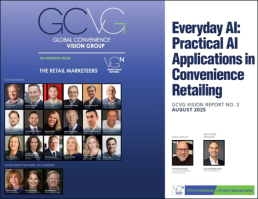
This is the full transcript from the GCVG quarterly meeting on July 22, 2025. The Vision Report based on this meeting, “Practical AI Applications in Convenience Retailing” containing GCVG Views, an executive summary of the discussion and and additional resources are available under Meeting Components on this page.
GCVG July 22, 2025 Meeting Transcript
Meeting Facilitator
- Christian Warning, Geschäftsführer / Owner, The Retail Marketeers GmbH
GCVG Member Participants:
- Joe Boyle, CEO, FreshStop
- Mert Dunder, Head of Operational Technology, Petrol Ofisi Group
- Santiago Ferreccio, Head YPF FULL, YPF SA
- Chris Hartman / Vice President of Fuels, Advertising, and Development / Rutter’s
- Theo Foukkare, Chief Executive Officer, Australian Association of Convenience Stores (AACS)
- Zsuzsa Hordai, Head of Strategic Projects, SPAR International
- Jesper Ostergaard, CEO, Reitan Convenience Denmark A/S
- Sergio Padilla Navarro, Global Networks Director, Sergio Padilla Navarro
- Claudio Reboredo, Partner – Owner, FGC Fuels Marketing
- Caroline Rowan, Head of Retail Operations, Musgrave Retail Partners
- Patrick Schnell, General Manager, Petro-Center SA / PC-Tank Sàrl
Presenter
- Joerg Heilingbrunner / CEO / Scheidt & Bachmann Energy Retail Solutions GmbH
Vision Group Network Founders
- Myra Kressner, Founder, Kressner Strategy Group
- Eva Strasburger, President, StrasGlobal and CEO, Compliance Safe
- Roy Strasburger, CEO, StrasGlobal and President, Compliance Safe
Meeting:
Christian Warning:
A warm welcome to everyone. It’s great to see you all here again in our third meeting. We hope we can provide some more thoughtful leadership today.
Before I start, I will pass it over to Myra and Roy for a bit of housekeeping to remind us what we are doing here.
Myra Kressner:
Thank you, Christian. Welcome, everyone. We appreciate you taking the time to be on our Global Convenience Vision Group leaders meeting.
Some brief housekeeping: We are recording this discussion. And as you can see, this screenshot reminds everyone of the antitrust statement and publication acknowledgement that every member and meeting participant has signed.
And a few reminders. Please keep your camera on as much as possible. And conversely, please keep your audio on mute unless you’re speaking so that any ambient noise is minimized. Because we do want really good exchange, please use the raise-hand icon or just raise your hand for good conversation flow, unless you’re clearly in an exchange with someone back and forth. If you need to leave the meeting for any reason, please just let us know and then return when you’re able. As we’ve said, we do want very frank and open discussion, but do feel free if you want to make an off-the-record comment, just let us know that what you’re about to say or what you have just said is off the record.
One other point, all Global Convenience Vision Group members are receiving the Vision Reports from all of our Vision Groups. We send each Vision Report directly to your inbox, so if you’re not receiving it, please let us know. We want you to share all of these Vision Reports, certainly the Global Vision Reports, with your colleagues. And we absolutely encourage you to share them even more broadly with all of your industry partners and associations and the media. Any questions on this?
Christian Warning:
No. And I’m happy to have you reach out to me for content and slides from this and previous meetings, but they are available for everybody in the world. So share the links in your organization. I think that’s the purpose of what we are doing here.
Thank you, Myra, for reminding us.
Myra Kressner:
Yes. And just before I turn it back to Roy, I do want to ask Robert Hampton, VGN’s director of strategic growth and initiatives, to share some exciting news from the Vision Group Network. Robert?
Robert Hampton:
Thank you, Myra. Greetings, everyone. As you might remember from our last meeting, my name is Robert Hampton and I’m a consultant within the retail and convenience space. I’ve been working with my colleagues here at Vision Group Network to develop some exciting new programs. You should have received an invite for our very first Vision Group Network Virtual Global Summit. At this summit, we’ll be bringing together members and supporters from all seven of our Vision Groups. And this will be on November 19th at 11 a.m. to 2 p.m. Eastern Time.
We expect close to 100 participants in this virtual gathering and already have had over 70 members accept the invitation. We have an exciting agenda, including futurist Gerd Leonhard as our keynote speaker, as well as reports from all seven Vision Groups from all over the world. You’ll be able to hear the findings and insights from your peers and colleagues from foodservice, EV, leadership, technology, and others. We also have a section on the VGN website that will be updated as more details become available. Again, that’s on November 19 at 11 a.m. Eastern Time, and if you have not received an invite, please reach out to me and I’ll be sure to take care of that for you.
Secondly, I’ve been putting together ways to partner with academic institutions to leverage all the great student resources in the form of a hackathon or research or capstone projects as part of their class. We’re in the early stages of working this out with an institution, and we’ve seen success with this approach within the industry. Plus, there’s a lot of interest on the academic side as they are always looking for real-world problem solving and exposure, exposing the students to the industry. In fact, in my previous job, I had really good success with this where I created a pipeline of new hires that we were able to bring in to the company who over a couple years gained insight and experience within the convenience space. So more to come on this effort. If you have any questions or suggestions on either of these, please feel free to reach out. Thank you, Myra.
Myra Kressner:
Thanks, Robert. Roy, did you have anything you wanted to add?
Roy Strasburger:
Welcome, everybody. We are glad to have you here. As Robert mentioned, VGN continues to grow, and we try to continue to add more value and information to the convenience sector. We really appreciate your participation because it makes this happen. So thank you very much. Christian, on with the show.
Christian Warning:
Thank you very much, Roy and Myra.
Today, we are discussing the topic of the power of AI in energy retail. I think we all have participated in many, many conferences over recent years where AI is a big buzzword. Somebody presents the newest tool or talks about how to transform a still picture into a video. We all see that day after day, and we notice the speed of those AI initiatives is enormous. So I had the idea to have Joerg Heilingbrunner present to the group. He is CEO of Scheidt & Bachmann who will talk about generative AI.
I asked him to share some use cases that are dedicated to our industry and already applied by our industry rather than talk about fancy AI tools or something. Instead, to discuss with you real cases. He’s going to give a presentation of places where AI already has taken an important role in our industry, as well as look together with you at what might be coming next. We presented this to the German Handelsblatt and got very good feedback. Handelsblatt is the German equivalent of the Financial Times or the Wall Street Journal, a leading economic newspaper, and we participated in a webinar there for our industry.
Joerg, thanks for being with us. Please introduce yourself.
[SLIDE 1: Siqma: The Power of AI in Energy Retail]
Joerg Heilingbrunner:
Thank you, Christian. Welcome to all of you. I really appreciate the opportunity to join this international group. I think convenience is getting more and more important within our industry because of the changes we’re all facing.
My name is Joerg Heilingbrunner. You can call me Joerg. That’s very easy. As Christian mentioned, I’m based in Germany. That’s where our company is located. It’s close to Düsseldorf. It’s in Mönchengladbach. Some of you might know it from soccer. The local team was pretty successful in the ’70s.
[SLIDE 3: Strategic Approaches]
AI I work for a family-owned business called Scheidt & Bachmann. We operate in about 50 countries. And we are one of the leading European suppliers and back-office suppliers. For me, it’s very important, as Christian mentioned, not to talk about AI as buzzwords, but to really give you some ideas, some use cases. And I’m very much interested in getting your feedback because that’s what we need in order to progress, in order to improve the situation. Because at the end of the day, there needs to be a business value for the application of AI. It’s not for itself. There needs to be a business case.
[SLIDE 4: AI will take on a variety of tasks …]
Briefly about me, I’ve been in the industry for 20 years. I’ve worked with corporations and in the consulting business. I’ve also been an entrepreneur, and I’m always very curious to know what’s next, what’s happening. AI, I think, is challenging all of us. As Christian mentioned, it’s a friend of your daily business. So that’s why I’m very, very happy and very pleased to share my and our thoughts about AI and get your feedback.
[SLIDE 5: AI as an Everyday Problem Solver]
My message is very simple today: AI is an everyday problem solver. You can use it for everything. Of course, you have to take into consideration some basic principles. First of all, it’s about data. And many of us have lots of data in our companies, but most of the time the data is not clean, it’s not structured, and it’s not really accessible. So that’s the first thing that needs to be done. You really have to clean your data in order to get the most benefit out of it.
Number two is the involvement of people, because it’s really a mindset change. We all need to recognize that people are concerned about becoming redundant because AI is just taking over their jobs. And that’s, I think, one of the major challenges, to get people involved and to convince them that AI is helping them to make their job easier and to make it more exciting because all the repetitive work can be done by AI.
And last but not least, of course, you have to measure the impact, as I mentioned in the beginning. Because if you spent money and it costs money, then of course you need to either increase the efficiency or add additional revenue, or you come up with a totally new business model. I think that’s what is needed to make AI successful and to come up with sustainable results.
So, AI is an everyday problem solver, and what we have done is just share with you some use cases that we have been developing in our company and that we have been using with various customers and with various teams. For me, it’s important to see what the benefit is from these use cases. The purpose of AI is not AI itself. It’s making an advantage within the company or with the customer.
[SLIDE 6: Developer support via Code Generation]
So let’s get started with the first idea. You all know that creating AI requires developers. It takes time and we have issues. The code drops are delayed. What we have done is we introduced a TuringBot, that means we are improving and we are generating faster codes, improve the testing. This speeds up the software development, reduces bugs, and shortens the time to market. At the end of the day, it’s beneficial for all of us, for all the customers, because the faster you get the new code drops, the better or the faster you can implement it and the more efficient you are within your competitive environment. So that’s one idea or one use case we have been implementing.
Christian Warning:
Let me chime in here for a second.
Joerg Heilingbrunner:
Yes, please.
Christian Warning:
About cost reduction, that’s obvious, but how would you value quality improvement in code generation?
[SLIDE 7: Improved BOS BI/reporting]
Joerg Heilingbrunner:
Well, we definitely see a significant increase in the quality of the software because you can apply not only a generated code, but you can test it. That reduces all the cycles, all the repetitive work that usually needs to be done when you deploy a code drop. You find bugs and you have to do it again and again.
Christian Warning:
When it comes to BOS (Business Operating Strategy) BI (business intelligence) reporting data, clients or customers often suffer information overload from all the data. But there’s that famous quote, “Data is the new oil.” It’s so important and such a great opportunity for our industry. How is AI helping in that area?
Joerg Heilingbrunner:
Basically, AI is helping to do a better evaluation of all the data. Data is fine, but if you haven’t got it structured, then it’s not very helpful, not very useful. It is important to have a dashboard, a tool that allows you to make fast decisions in terms of what you can generate from your sites in terms of sales, in terms of revenue, and in terms of the product mix. That all needs to be aggregated, and AI helps you to make better predictions and to have a much faster basis for decisions.
Christian Warning:
Adopting AI is about the user experience for your clients, but it’s supported by language models that can analyze the data and get reports out of that. How is that connected?
Joerg Heilingbrunner:
Yes, that’s a very valid point, Christian, because in the past you had to set up your dashboard, and now you can interact with the back-office solution by just asking for certain reports or by asking for certain information or certain data. And it’s really very, very convenient in terms of how fast you can get the information, or you can have it drawn in a certain chart.
[SLIDE 8: SIQMA FlowMax.AI informs customers …]
Christian Warning:
So we’ve got the business function, but at the end, the consumer is the main user we center our business on. How do your tools and AI help in the customer journey and with the consumer experience using our sites and locations?
Joerg Heilingbrunner:
Electric Vehicles For one example, we analyzed and dove into the consumer transformation to EVs. EV charging is growing in all countries on differing growth paths. And the user story and the customer journey are different. It’s fully digitized, and the customers expect much better transparency in terms of the availability of EV charging installations.
We developed an AI-based tool to give the customer a better prediction of the availability of charges. The availability of charging is still limited. So there are peak times when you can hardly find any vacant EV chargers. So using AI and with a grid analysis, we can predict the waiting time for a customer to use an EV-charging installation. That really helps to improve customer satisfaction. It improves the efficiency of the entire setup. And at the end of the day, you have a happy customer. He will come back, and he will use your facilities.
Christian Warning:
That’s a great use case to get them in, to get them to our sites, but of course, there’s also something on the other side in handling and controlling our consumers. How is AI helping here?
[SLIDE 9: Theft protection through self-checkout monitoring]
Joerg Heilingbrunner:
Self-Checkout Yes, it’s about improving the customer journey within the convenience store. We are talking about self-checkout, which is spreading in all retail businesses, and there’s still room to grow in the fuel retail business. With a continued lack of labor and increasing wages, there is a need for more retailers to offer self-checkout units. One of the challenges is dealing with fraud or theft so that it does not exceed the benefit of self-checkout. That’s why we developed a self-checkout solution with cameras detecting actions that might endanger your margins. This is a very good example of an automated customer journey combined with AI usage.
[SLIDE 10: Visual Asset Monitoring]
Christian Warning:
Talking about cameras, we all have CCTV on our sites, in the stores. How can you bring that previous investment together with the AI system? Is there connectivity and new use cases for our camera technology?
Joerg Heilingbrunner:
Yes, right. That’s particularly useful at unmanned sites, locations where there’s nobody on-premise. We are developing a solution that makes use of existing camera systems and uses them for visual asset monitoring. Because there are no employees on site, you don’t know when your POS system is not working, and customers don’t tend to call you if the solution or the system is not working. They just leave and they don’t come back. So we have been combining existing infrastructure together with the observation of the assets, providing you input and giving you ideas for preventive maintenance or reactive incident management.
[SLIDE11: Beat drive-offs]
Christian Warning:
I’ve heard that some people fill up but don’t pay. How is AI helping here?
Joerg Heilingbrunner:
Computer Vision Yes, that’s right. That happens still in many cases. Whether it’s unmanned or manned, it’s happening. If you have pre-authorization, then it’s fine. But on many sites, we don’t have pre-authorization, so it’s very easy for the drivers just to drive off. What we do is use the feed from these cameras and analyze the footage of drivers, of the cars, of the behavior, because based on the people and the car, you can draw some conclusions of whether this might be a customer who might drive off. That helps you to prevent this case and of course to reduce fraud with AI usage.
[SLIDE 12: AI as an Engine for Retail Media Networks]
Christian Warning:
Retail Media One growing strategy for a new income stream is retail media networks, and AI is the engine for that, isn’t it? This is a really big topic. Everybody is aware of the potential of retail media networks. The prime example is Amazon online. As an online retailer, they sell a lot of advertising around their online marketplaces. But also, brick-and-mortar retailers, like Walmart, are bringing in about $5 billion U.S. this year on combining their digital signage in their retail media network and their first-party data. They bring that together with their brick-and-mortar POS, as well as their digital marketplace. This is all what we call a retail media network. How is AI helping drive that business?
[SLIDE 13: Visitor prediction to optimize business processes]
Joerg Heilingbrunner:
Yes, as you mentioned, Christian, I think it’s the fastest-growing segment of Walmart’s revenue. You have so many data sources, and AI helps you make better predictions. It can improve visitor flow and the output of your campaigns. You can incorporate factors like the weather. You can use local events and historical data, and that helps you better predict the number of visitors you can expect. And then you have a better base on which to target customers. It really helps you to increase your margin, to increase your [product] turnover.
[SLIDE 14: Clever advertising]
I’ve got two examples of how you can do that. Let’s say it’s clever advertising. You can evaluate or assess a customer via AI and create targeted loyalty or targeted customer approaches in terms of what the person really needs. Because it’s different if you have a family or you have a single person. They need different products. So it allows for customer-targeted activity. And that’s all based on the various data you have in your company database, coupled with data from the outside, from the community or surrounding areas.
Christian Warning:
Geofencing That’s programmatic advertising. That’s great on site. Let’s say you come to the store in a specific type of car or from your license plate we can tell you’re coming from a specific region, then when you step out of the car, you have an expensive Birkin bag in your hand or something else. With that, we can determine the right advertising to put on the screens.
We also see more and more connected cars giving us geofencing data, right? From that, we can tell if you’re a loyal or registered customer and on a given day provide a special promotion to your car to increase the traffic. Is that also possible?
Joerg Heilingbrunner:
Yes, I think you’re raising a very, very important point because cars are software-driven, and they connect to many systems. We have been connecting them to mobile payment for fueling. We also have connected them for mobile car wash. You can also do pre-ordering for various shops. So the car is an integral part of the entire customer journey.
What is really important is to start that journey early, not only in the store or on the forecourt, but extend it to the cockpit of the car. By doing this, we can make it even more convenient for the customer because they can make their decisions upon traveling to a site and not when they enter the shop. So they can be targeted at a very early stage.
[SLIDE 15: Clever couponing …]
Christian Warning:
Loyalty Programs That’s bringing them back to the store. That leads to loyalty. And maybe you can speak to the importance of loyalty. It’s always a big debate in our industry whether you should have a loyalty system or not. The argument is that you give away margin to customers who are coming in anyway, rather than better serving the needs of your consumers because you know them and you’ve got the data. How important is loyalty from your perspective?
Joerg Heilingbrunner:
Well, to my mind, loyalty is key to really trigger and to bind the customer to your company because the competition is very high in terms of product offerings, in terms of pricing. I think you need a very sophisticated loyalty program, and it needs to be customized. It doesn’t help if you have a general loyalty program. We see that at many companies. AI really helps you to make it targeted to the specific needs of the customers. For example, with clever couponing, you can really increase the redemption rate and loyalty to your brand.
Christian Warning:
When you consider the current status of the industry and applying AI, what are the key learnings from your side and what is next?
[SLIDE 16: Key learnings]
Joerg Heilingbrunner:
Well, I think the key takeaway from all these use cases is: Retailers need to fundamentally rethink how AI can be applied within their organization. You really have to get the people on board. Whether you do it as a service provider as we are, or whether you implement it within your company, get the people on board, get them convinced, and allow them to see the benefit, how it really helps them, and how it helps to grow the business.
Number two is that you really have to define and identify the right data because we have so much data in our companies, and we have to structure it. We have to understand how we can leverage this data.
And number three is based on the data and the customer journey, on the customer’s authenticity. What are the real use cases? Define use cases and start with a POC (proof of concept). Just try it; try it out. And if you don’t succeed or if the customer does not appreciate it, then okay. It was a good try. Try the next one. Don’t be hesitant, because if you’re hesitant or if you’re not really trying it out, you will not be successful.
And last but not least, it needs to be compliant with legal and moral principles within your company. I think that differs from continent to continent, from country to country. But I think it’s crucial for credibility and what your company stands for.
Those are the four takeaways. Get people on board, define the right data, focus on the right use cases, and make sure it’s compliant.
Christian Warning:
Thank you very much. We have many questions from the group. Let’s start with Jesper. You are in the loyalty game, and the Nordics are far ahead in using digital technology within Europe; you’re spearheading that. What’s your experience over the last years? Is acceptance by consumers still growing? How important is gamification? Is there really a need for it, or are you questioning it year after year in your budget planning?
Jesper Østergaard:
That’s a very good question. Seven or eight years ago, I was personally really, really keen on developing loyalty programs. And I had been visiting some of the big retailers, among others, Circle K in Hong Kong, which had a very strong loyalty program. I think I’m less keen today compared to seven years ago, meaning that, we have a loyalty program and if we should continue developing that, we need to make sure that first of all, it’s profitable. Secondly, that it sticks out because everybody does something. I would say if we look at our loyalty program today, I’m sure it is net positive for us, and we keep developing on it. We are currently working on a new setup, which we’re working on together with our Swedish company, and we will launch that in ’26.
But I think the challenge is, is it a true loyalty program or is it just a discount program? And when I ask that question, I think a lot of so-called loyalty programs today in retailing are basically discounting programs. It doesn’t really, really create increased loyalty from your consumers. And if that is the case, I think it’s a waste of time and money and resources in general. But if it actually creates true loyalty, I think it is key to your business and to develop successful results. We are in a situation where I would say up to 75% of what we do is creating true loyalty.
But some years ago, I was listening to a guy from the UK, who had been working with loyalty for big companies for the last 20 years. And he said that the most loyal customer you have might only spend 50% of his or her spending, for instance, for coffee, in your business, although you think they’re very loyal. So there’s still a lot of business to get into your own business if you make a really good loyalty program. And I think today, one of the best loyalty programs in the world, in terms of creating true loyalty and in terms of cost, is Starbucks. They’re probably the best currently in retailing.
That’s a long answer to a short question. I do believe loyalty is important, but we have to be aware not just to introduce a discounting program.
Christian Warning:
Roy, you have a question?
Roy Strasburger:
Security Yes. Christian. Thank you very much for the presentation. I think it was very, very good, Joerg. One thing I didn’t see in your slides was something addressing the question of privacy and data security, especially when you’re dealing with AI and large language models. Did you have any learnings from that as far as keeping your company data secure?
Joerg Heilingbrunner:
Well, Roy, I think you might know that Germany is very strict on data privacy and those topics. It’s a very important step in our programs. And what we do is require that the data all be anonymous, and we require agreements with the companies we work with and the people from whom we are collecting their data.
Roy Strasburger:
But in regard to creating your learning modules, are you creating a ring-fenced data pool that is not accessible to other companies, or are you using a public AI program as part of your learning module?
Joerg Heilingbrunner:
No, we use what I’ll call a private cloud. So we’re not allowing others to use our data.
Roy Strasburger:
Okay, thank you.
Christian Warning:
Self-Checkout And in terms of self-checkouts, that’s a massive investment and many retailers are trying that. There is the effect of reducing friction. But we have concerns about age verification. We’re challenged by where to put the self-checkouts. Caroline, I know from some of the Irish operators have stopped using the self-checkouts for fuel because they have so many drive-offs because people are clever in Ireland. They say, “I had pump number one with only 10 liters,” but they actually had number 10 and a full tank. What’s your experience with self-checkout?
Caroline Rowan:
Yes, we have self-checkouts in quite a few of our stores. You’re right, we run a lot of forecourt sites. For a lot of them, we don’t actually have the integration with the fuel supplier, so we haven’t been able to have them connect with our self-checkouts. But I was interested in the discussion during the presentation of drive-off prevention. We do have a number of high drive-off sites, regardless of self-checkouts or not. We do have customers who have to prepay, which then means the likes of loyalty and all of those things don’t really work. So a lot of the current theft prevention, whether it be self-checkout infrastructure or drive-offs, disrupts your customer journey. Is there an opportunity where AI enables you to manage your shrink problem but also maintain a better customer experience? How could you build that?
No one has mastered payment at wet sites in terms of the management of fuel. We see a lot of customers will either pay at the pump or it becomes a separate transaction. Beyond self-checkout, if you could remove the need for people to even have to prepay for fuel, that opens up the opportunity for the likes of loyalty apps and other things can come back into play. So I think AI could definitely improve the customer experience.
Christian Warning:
In terms of those countries where we have lower labor costs, what’s your view on self-checkout? Are customers asking for it and does it take friction out of that process, even in a convenience environment? Or are you not as keen as in the high-labor environments of Northern Europe, for example? How do you see that?
Joe, do you have a word on that? You operate both supermarkets and convenience stores. Is self-checkout a topic you are thinking about or using?
Joe Boyle:
Yes, we actually tried it quite a few years ago, Christian, in some of our stores. And we had union problems where the union actually staged a strike because they said we were taking away their jobs. That made us look at it from another angle. And look, theft is quite a big issue for us. We do have a few car drive-offs, as well, but we’re using facial recognition, body movements, those types of things, to recognize people. We use AI in that way in South Africa.
Christian Warning:
I see the point from the unions here, but it’s reallocating staff in different positions in the shop. This is what we see when it comes to self-order terminals to improve the foodservice business. I see it here in Europe. Having a self-order terminal is a big check mark in convenience stores. It says that you take the foodservice business seriously, because every QSR has got self-order terminals. If a consumer sees the self-order terminals, he knows they have a foodservice offer on eye level with QSR. What’s your take on order terminals?
Joe Boyle:
Well, look, there are a few elements around it. Theft is one thing, but labor is important. We run at 40% unemployment, so to get that message across wasn’t so easy. So we’ve battled a little bit with that. We’ve got the union side, and we’ve got the theft side. So we said, “Okay, the labor is an abundance here.” Some of the bigger problems we had was actually training them once we get them into the stores. So we’d rather focus our money on those elements, training the staff, making sure the customer service is good. I travel quite a bit and sometimes I come back to South Africa and I say, “I’m so glad to get back to South Africa, where I get good customer service.”
Now that sounds strange because we say we battle those types of things, but when you’re used to face-to-face interaction and ease of making requests, [you get used to it]. And it includes convenience and QSRs. Even with simple things, like “Don’t put onions in it.” We find that works a little bit better for us. So we probably stick to that and use the technology for elements of theft and to cut credit-card theft, those types of things.
Christian Warning:
Oh, interesting. So you want to keep that competitive advantage of having good people. Yes, that’s a big asset. Caroline, you’ve got a comment?
Caroline Rowan:
Yes, it is probably worth adding. Especially in our smaller stores, our self-checkouts are more of a service proposition. They don’t bring us huge labor savings because we still have to man them to authorize some of the transactions and things like that. So we don’t get the benefit of a multiple where one person can man 20 checkouts, especially with the likes in the fuel transactions. That’s even more true in our smaller stores, where there’s a customer expectation of the service proposition. The units give us that more so than saving us labor. Because in most cases you still do have to have them manned to some extent for the levels of authorization that are required. In the bigger stores, it does absolutely give us labor savings, but in some of the smaller stores, it’s more of a service proposition than a cost saving.
Christian Warning:
Retail Media Chris, in your network in the U.S., retail media networks are a big topic. There are now service providers for our industry, which are providing services for smaller networks to join. Are you looking into that or are you active in the retail media network space? Are you working closely together with the chief suppliers on first-party data exchange? Do you use the advertising space for third party advertisers?
Chris Hartman:
As a reminder, I am Chris Hartman. I’m one of the owners of Rutter’s. I run our fuels development and marketing teams. We’re in York, Pennsylvania, in the United States. We’ve got 90 locations currently. We’re building 14,000-square-foot stores at this point, but we could keep going bigger depending on how things develop. We try to continue pushing innovation and foodservice, technology, gaming, and all sorts of other different ways. So we’re a growing company and still a family-owned business. For us, Christian, to answer your question, we do a lot of different advertising inside of our stores. We continue to develop our media capabilities and look at ways to monetize those capabilities. We provide space above our beer caves, coolers, checkout, and now in our new stores in the gaming room, bar, lounge areas. And so I’ve been talking to a number of different companies.
One actually is able to provide a way to interrupt in our bar lounge area TV commercials, using AI to basically put the commercials we want on when the sporting program is not playing. And so we can then monetize those, whether it’s our vendors paying for it or vendors that they work with on a national level. So if there’s a construction company that’s advertising on regular TV, but there’s another one that pays them to do it for me, I go, well, why do I really care? I’d rather have the one that pays to do it, and I’m not a construction company, but that’s okay. When I get into my store, I have a little bit more sensitivity to advertising things that aren’t related to the store. Again, having a law firm or someone like that be advertising in my store, because really the point of them is to promote my deals or new products or different areas.
So that’s a part that I’m working on to continue monetizing that in the right way by working with vendors and improving our capabilities internally. We do have it centralized where we’re able to use the technology to change the size of graphics, depending on is it a five-screen area, is it a one-screen area? Are we going to have video or not running? Is it a store that has alcohol or doesn’t have alcohol? So there’s different ways to categorize and move those across.
I think there’s a lot more things that can be done in the retail media world. But to me, I think it’s still a little bit of an evolving thing because, again, how much do you want to be advertising? How much money are you actually making by advertising these other things inside of your store that you don’t sell versus things that you do sell? If you can monetize the things you do sell by having someone like Philip Morris promote their brand inside your store versus their competitor, that’s how you can play them against each other. That’s what we’ve tried to do in terms of monetizing what we do inside our stores.
Christian Warning:
AI Thank you very much, Chris. Zsuzsa, in terms of AI, is there a lot of pressure from your brand partners around the world who are looking to you as a brand provider to help them find how they can apply AI best, so that you can then adopt the best practice [inaudible] to others? How is that working?
Zsuzsa Hordai:
Yes. Well, of course, it’s the buzzword. It’s been the buzzword of the last three years now on the CEO level, as well as on business functions. We do work a lot with our partners and countries to make sure that we provide guidance to them. Not just on the technical side, because there are lots of areas around AI, and if you talk to any tech provider nowadays and they don’t have AI on their specification of product tools, you’re not even looking at it. Even a desk is now AI-capable sometimes, so you get a lot of those. You really need to filter out what’s real and what’s just simple machine learning or something that’s been around for 40 years now.
One concern has already been mentioned by Joerg, and that is the ethical use of AI. That is really on the top of the agenda, especially on the C-level teams. What are we going to do with AI, because it takes an enormous amount of energy to run, especially if you’re learning large language-model-based solutions?
When you claim to be a sustainable company and yet you’re running these gigantic algorithms in the background, how much energy are you using up versus how your sustainability goals are proceeding, and how do you align those? It’s one of the questions that we have currently on top.
There’s also the question around personalization when it comes to marketing with the help of these amazing tools. We get to that level of personalization, like Jesper was mentioning: Is it just a loyalty app for a general discount, which doesn’t really make sense in terms of customer stickiness, or is it a truly personalized solution where we can offer real value and real loyal solutions to our customers?
We have a lot of use cases where some of our countries have been very bold with trying things, as Joerg mentioned. They try something to see if it works, and we disseminate that knowledge across our network. One of the most exciting ones, I think, was last year when one of our countries launched a TV ad that was made purely by AI. No real video was taken, and the cost was a fraction of a real ad.
I think we saved 92% of the cost. That’s a real benefit. When you have a balance sheet and pressure on the bottom line, to find any savings is a good one. The other one is AI-generated music in store, which is quite exciting and how you can also leverage that. We do see a lot around those use cases.
As a brand owner and as a company that is looking for innovative solutions, we try to make sure that all of our countries benefit from this, so we do have lots of internal learning and sharing because it’s a new area for everyone. No one has the answer for the best use case for AI at the moment. We do a lot on the back end, on the demand planning and supply chain, where we see huge benefits of it, and then as I mentioned already on the creative side, as well.
Christian Warning:
Thank you very much, Zsuzsa. Roy, you want to chip in here?
Roy Strasburger:
Thank you, Christian. Zsuzsa, would you expand a little bit on using AI to create music in the store? I’ve not heard of that application for AI before. How are you using it?
Zsuzsa Hordai:
It’s been very interesting. We decided to venture into it in one of our smaller countries, where we are a market leader. They basically used a tool to generate 50 songs, and then they invited a focus group of customers, and the customers selected the 25 top songs they liked most. Those songs have been playing in the stores since, and we had a very good return on investment on that one.
Roy Strasburger:
There are no royalties because it’s AI-created music, so you’re not paying anybody for it. Do you have any extra mental health costs from the employees listening to the same 25 songs over and over and over again?
Zsuzsa Hordai:
I think you can ask that question from every retailer who has Chinese New Year or Christmas or any specific holiday season. I don’t know how they cope with it, honestly. Or if you’ve been to one of those stores where they constantly replay their [inaudible] sound, feature logos and stuff. Yeah. Those are challenges for sure.
Roy Strasburger:
Fascinating. Thank you.
Christian Warning:
That’s a great example, and it shows how fast new applications are coming and how they were devised. Sergio, being in such a massive, giant company, providing transparency about these developments must be very challenging. What are you creating your own AI or are you buying off the shelf and applying ready-to-go tools? How are you managing this process of transformation driven by AI?
Sergio Padilla Navarro:
Do you have an easier question to answer or is that the only one that you’ve got? [Laughter] No. I think use cases are all around. One of the things that we love about being retailers is that opportunities are all over the place, and prioritizing the opportunities we tackle is I think a big part of the game. The strategy followed, at least in this organization, is more of a pull than a push approach toward the business units. Of course, solutions are made available for the different business units, and they can cherry pick what they want to take to each operation.
But the business unit needs to make the pull because they own the result, they own the P&L, and they have to own the business case for each application. It’s AI or not AI. That is not different. Maybe in AI there is additional support in letting them know what is possible. I think that is the biggest difference in how you handle the AI-related portfolio of use cases versus other use cases or the other portfolio of potential initiatives. I think a bit of additional stimulation and leveling the field and the knowledge of the possibilities, that is crucial for having an effective pull approach on AI solutions.
Christian Warning:
Thank you very much. Joerg, is there an AI tool that controls within a large corporation what AI projects are going on?
Joerg Heilingbrunner:
We’re using Jira as a project-management tool. We use this tool to align our different projects. But there are different usages. It depends really on what tools or what projects a company is using. There are so many different AI tools, as we’ve heard, for creativity or loyalty, a wide range, and there are many new ones coming up every day.
Christian Warning:
Mert, you are dealing with thousands of dealers who run your sites. In that environment, how are they challenging you? Or are they just doing it and then informing you of the results? How’s that working with all these new techniques and digitalization?
Mert Dunder:
Thanks for asking, Christian. Actually, we are implementing our customer-facing solutions and AI-enabled projects. We are planning to transition our ERP (enterprise resource planning) systems to versions that support AI and other technologies. That’s the biggest challenge for us, that AI-supported ERP. A second thing is that, as you may know, we have 2,600 stations. To implement something to all the stations is the biggest challenge for us.
I want to thank Joerg for his presentation, and I have a question for him. He talked about the camera solution. How do you monitor the camera availability, Joerg, in terms of partial visibility? As everybody knows, cameras cannot see every nook of a store. They may have only partially site lines. What’s the solution for this?
Joerg Heilingbrunner:
That’s a very valid point, Mert. What we have been doing, we have been conducting site visits to test how efficient camera usage is at that stage. We make the operator aware that there isn’t 100% coverage. Additional cameras might be needed to get a better overview, because right now maybe you have to have a certain view on certain lanes and now you want to extend the picture. That might cost some additional investment, depending on the full scope of the AI use case.
Mert Dunder:
Yes. Then that’s our biggest challenge, by the way, because we put at least three cameras in each station, one on the pump side with a view of the opposite side, one looking at the tanks, and the number can go up and up from there. That’s the issue. It comes down to money. How can we decrease the amount of money that we are paying using AI for the next generations? What do you think, Joerg?
Joerg Heilingbrunner:
Well, you can’t have 100% coverage with that amount of cameras. You have to evaluate what the benefit is and how much fraud or theft you can avoid. Then based on that, you create a use case or a business case. Then you need maybe 20, 30, or 50 sites in order to make an evaluation for the rollout. I wouldn’t go to all 22,600 at the same time. Instead, place cameras at different scopes and different vicinities, and then you make a plan for certain clusters of stores.
Mert Dunder:
How can we improve on singularity? I can’t use the same AI on all of our stations. It becomes harder and harder every day.
Joerg Heilingbrunner:
Yes, that’s right, but also AI is learning. The more data you generate, the better your AI solution will become. That’s a gradual improvement. That’s what you have to take into consideration, as well.
Mert Dunder:
As you mentioned, we must start with a POC from a small group and then extend it as we find success.
Joerg Heilingbrunner:
Yes. Fully right.
Mert Dunder:
Thanks.
Christian Warning:
Sergio.
Sergio Padilla Navarro:
On the same topic, where do you see the limitations of the use of AI beyond identifying theft? I understand that you can blacklist customers, you can require customers to pay in advance if they have fallen into certain behavior. Beyond identification, what is the use case for AI in theft management? Can you use AI to push charges to people’s credit cards more effectively? What is the limit of AI to transactionally push the charge onto the fraudulent customer’s credit card, assuming that you have identified the customer and you have the credit card information of the customer?
Joerg Heilingbrunner:
Well, I think we know it from the delivery companies. They analyze [the data] in terms of where you live, in terms of what behavior you have. They’re really help limit credit theft. They try to minimize those clients or expel them from certain usages via analyzing the data. That could be one use case. Of course, you always have to be in line with the data privacy, but with the data you generate and the behavior you recognize, you can use that to meet the customer’s specific needs.
Christian Warning:
To clarify, Joerg, let’s say you’re coming into a store where you are a loyalty-registered customer. So, I’m a loyal customer at your store, and I’m stealing something. Can we use technology, like the [Amazon] Just Walk Out technology, and immediately put it on my credit card because I’m a registered loyalty customer? Is that possible?
Joerg Heilingbrunner:
Well, with theft and fraud today, what you can do is send an email or a message to that loyal customer and tell them, “I think you have maybe just forgotten to pay certain …”
Christian Warning:
A friendly reminder.
Joerg Heilingbrunner:
Yes. “Friendly reminder, you have forgotten to pay for these products. We can put this on your credit card. Otherwise, we will charge you a fine.” I think it’s a good thing if you know your customer, then you can communicate with the customer. It’s much better if the customer is unknown.
Christian Warning:
Is theft reduction one of the major cases where AI tools are helping? Is that already an investment case to consider when you are thinking about installing more cameras than you have at the moment? Claudio, I remember when we had a discussion on the NACS International Board of Directors about the number of cameras in the Just Walk Out technology. I think it was Santiago who said, “If we install 400 cameras in Argentina, people may want to steal the camera because the camera is attractive.” Luckly, the cost of cameras is reducing dramatically.
I know of cases where cameras in the shop are used to control the planograms. They help achieve compliance between FMCG (consumer product) companies and retailers by providing an easier approach than having people check the planograms [in person]. What’s your thought, Claudio, with all your experience in retail, on that issue?
Claudio Reboredo:
Unfortunately, in this part of the world, we haven’t had a lot of artificial intelligence. We probably go to emotional intelligence more than that.
Christian Warning:
I love it.
Claudio Reboredo:
For example, on a different but similar topic: They focus on shrinkage thefts or drive-offs. We have changed the focus to create a different approach, rather than using more technology. We centralized. I was fed up with mystery shoppers after using them for many, many years. Our employees are so clever, they can recognize a mystery shopper. We are working on centralized video cameras in one location, and we put two supervisors in a shift just to focus on the customer service experience, not on drive-offs. What we really want to create, Christian, was to attack some people’s behavior, particularly our employees’ behavior, in how the treat customers.
You probably saw in the news, there is a New York apartment building where you have a virtual guard at your door. We copied that approach and centralized it to focus on consumers. We still don’t have a lot of data, but we have created anecdotal changes in human behavior. For example, we learned that we have times when customers are waiting for coffee, and we found many employees off in the back of the store just using their cell phones. We have a company policy that says employees cannot use phones when they are on shift. We are in a part of the world where we have so many regulations, so we try to use cameras not for artificial intelligence, but to focus on customer service versus avoiding theft and loss.
My concern with AI, for a small company like us, is I can’t afford it. I just can’t afford the cost of this, particularly when I have to watch overhead costs that are killing us. I have incurred a very high and dramatic increase in technology costs recently, but I haven’t seen the benefit yet. That’s where we focus more than anything else.
The other piece is, we have our own QSR business here, and we are in the early transition to self-checkout or self-ordering. We added self-ordering [technology] in our first restaurant, where previously we had 100% human interaction. Now we have those small totems (or kiosks) and probably 50% of customers prefer dealing with the totem, particularly young people. We are able to save some money, and also we avoid problems getting food orders right because there is no human interaction. There is no problem with that. That’s our experience; it’s so far, so good.
Christian Warning:
Thank you very much, Claudio. Patrick, the Luxembourg view on this whole discussion here, how important is AI development for a smaller operator like you? You are in such an advanced country like Luxembourg.
Patrick Schnell:
It’s an interesting topic. To be very honest, we didn’t work much on the topic because we are in quite a unique situation. Our shops and activities are growing and growing, but it’s clear that we have to work on this topic. I found the presentation from Joerg very interesting, especially for the big EV companies. To be honest, we haven’t talked about this, and we adopted any use cases. I was very interested in the presentation as a discussion, but I cannot bring too much to the discussion. I’m sorry.
Christian Warning:
All right. Thank you very much. That’s exactly the discussion I think all of you are facing. How much do you need to be involved as a retailer when you have an ongoing business that is going very well? If it’s going very well, investment in digitalization and AI has to have an additional positive effect on the bottom line and not just be there. That’s what our retail business is about. Eva, you raised your hand.
Eva Strasburger:
I was going to go back to the comment about AI-generated ads saving so much money. I noticed over the last few years that companies were using influencers. They had contracts, there were branding issues, travel expenses, you had to fit them into your timing to use. But now I see stores in Korea and Japan are increasingly using AI-generated influencers. So they’re associated [with the company], they can do whatever they want, there’s a huge amount of freedom, almost zero costs. And some of them have millions of followers. Is anyone on here using an AI-generated brand ambassador or mascot?
Zsuzsa Hordai:
We did try it in one market, and we discontinued it. It was not a positive experience in that particular market.
Eva Strasburger:
Do you know why?
Zsuzsa Hordai:
We had negative customer feedback on it.
Eva Strasburger:
People just wanted to see real people. Was that recently, or was that some time ago?
Zsuzsa Hordai:
Yes. It was last year.
Eva Strasburger:
And what medium did you use? Because the ones I’m seeing are mainly on things like Instagram where people are used to seeing influencers.
Zsuzsa Hordai:
Yes, it was social media.
Eva Strasburger:
Okay, thank you.
Zsuzsa Hordai:
No worries. I do have a question, Christian, if you all allow me to the audience. There was one line which really caught my attention on Joerg’s presentation, to look at AI as an “everyday problem solver.” And my question to you all on the call, how many of you are actively using AI tools in your day-to-day jobs? I’m just wondering. If you can raise hands of something to poll the audience here? [Most participants raised their hands.]
So, almost everyone. Okay.
Christian Warning:
Are you using it within your headquarters at least, or do you have regular workshops where you bring people together and everybody shares the AI tool that they’re using at the moment or in their everyday work life? Or is that more a discussion at the water cooler over the coffee break? Zsuzsa, how has that transpired?
Zsuzsa Hordai:
Well, from our side, we started doing it this year because there are so many things going on and so many people did pick up on different solutions. And as Roy mentioned, we have to be really careful on what kind of tools people are using for what purposes and making sure that no proprietary data gets out into the worldwide web and into these large language models that are then being trained on your data. So we did have quite a few educational courses on that to explain the difference, and then really to encourage people to use AI as a helper in their day-to-day jobs. Use it to identify use cases that can save time and make people more efficient in their day-to-day office jobs. That’s what I’m talking about here. So it was the head office staff.
Christian Warning:
Thank you very much. Mert?
Mert Dunder:
In order to answer Zsuzsa’s question, I want to tell a little bit about what we are doing. At Petro Ofisi Group, we see AI and automation technologies as crucial, not only for operational efficiency but also for improving customer experience, strengthening our business decisions and archiving our sustainability goals. We currently have many exciting projects, by the way. For example, we are working on AI-powered demand forecasting and price optimization systems. These are allowing us to better understand the market. We are using chatbots and digital assistants to improve our customer service. We also focus on enhancing our warehouse and field applications with visual recognition technologies to enhance operational safety.
On the other hand, we are increasing efficiency in accounting and purchasing processes with RPA, robotic process automation, and developing predictive maintenance applications using IoT data. And all these projects allow us to make agile data-driven decisions, and most importantly, allow our employees to focus on high-value-added tasks rather than routine tasks.
And our approach to innovation isn’t limited to purchasing technology. It’s built on integrating it into our company’s business models, culture and customer-centered structure. Therefore, we work not only with our own internal innovation teams. We also work with stakeholders across the ecosystem such as startups, universities, technology partners, and continuously nurturing innovative ideas.
And lastly, I can say AI and automation are the heart of our transformation strategy, and our goal is to become not only a more efficient organization through these technologies, but also smarter, faster, and more sustainable organization.
Christian Warning:
Thank you very much, Mert. Very good insights. I think fuel pricing is a big topic where many people are using AI more and more for predictions, sales predictions, other predictions and maintenance, as Joerg said. And I am not surprised that Joerg, you raised your hand when Mert brought these insights together.
Joerg Heilingbrunner:
Workforce Congrats, Mert, and I think you’re fully right. It shouldn’t be only on efficiency but also on improving the product, improving the customer journey. I think it’s essential. Without the usage of AI, I think the company’s not using it will not be competitive in the next five or maybe 10 years. I don’t know, I don’t want to make a prediction, but I think it’s essential. As one of you mentioned, in terms of replacing people on the workforce, that’s not the case, because what you do is you add benefit to the customer journey because if you just hand over a Coke or a coffee, that’s not added value. So you can use AI for added-value work, increase the margin or do some more sophisticated recommendations. And also do all the repetitive and not very exciting stuff, the boring things that could be done by AI or automatizations. I think that’s very important.
Christian Warning:
Thank you. Eva, you have a comment on that?
Eva Strasburger:
Going back to talking about how you employ your staff, our other groups are talking very much about the change in the profile of their store employees because you’re now asking them to be a little bit more technical than some of them might have wanted to be. So they’re seeing changes in the types of people they’re attracting, and they’re finding it very interesting to be able to identify those within the store. For example, the employees who were always on their phone playing games. They’re now saying, you’re very interested in tech and AI. We would like to make you the tech person of the store. Come to us with ideas, share what you’re seeing out there, what you’re hearing, and bring that feedback to us. And they’ve realigned those interests with the employee so, instead of being bored, they get them more involved in the AI within the store. They said that’s proven to be quite successful as far as attracting employees.
And I know that a recent study, going back to people losing jobs, showed that in the States, they’ve seen a 30% decrease in entry-level jobs. That’s a big concern for students coming straight out of the university. And one of the things we were talking about with Robert with the hackathon is there is now a thirst for students to jump over that entry-level point, and through things like a hackathon, show that they are able to come up with solutions for the industry so that they are exposed to the people that sponsor these. They’re showing that they can actually skip that entry-level role and come in at a higher level in things like the c-store industry, so that’s been also an interesting shift.
Christian Warning:
Thank you very much. Any other comments from your side? Any questions as we have Joerg here as an expert on all the related topics we were discussing? Roy, you’ve got one.
Roy Strasburger:
Computer Vision Joerg, you had several references in your presentation about computer vision using cameras to enable AI to make decisions. In some of our other Vision Group meetings, attendees have spoken about wanting to use computer vision, but they find that the cost is still out of reach for smaller operators. Is AI providing a different way of using computer vision as opposed to what maybe was the standard two or three years ago to make it either less expensive to use or more accessible? And the second question is: Where are you storing the AI program? Are you using edge servers in the store? Are you using a central database or cloud computing that runs all these things? Where does it rest? Where do you host it?
Joerg Heilingbrunner:
Yes, Roy, thanks for the question. Maybe just start with the second part, with the easier one. We store it in cloud solutions, whether it’s private or public, but it’s secured so that the data is not accessible to others. That’s answer number one.
And for the first one of course, the starting point for this [computer vision] use case is that you have cameras installed and you want to leverage them or want to benefit from the already installed solutions, and you don’t want to spend money on new installations. So that’s why we use AI. And it all depends on the interface. It depends on how old your equipment is. The younger, the better it is, the easier it is to interact with because you want to have it API standardized (application programming interface). You don’t want to have customized interface. It is very, very expensive, and you have to maintain it.
I can’t give you a 100% clear answer, but it’s getting easier, and AI is definitely helping to improve the use of those existing cameras. It’s making it easier to build different use cases, even for smaller operators.
Roy Strasburger:
Thank you.
Joerg Heilingbrunner:
You’re welcome.
Christian Warning:
Robert?
Robert Hampton:
Thank you. Just to piggyback onto what was just said, I’ve worked with computer vision quite a bit. As part of [technology standards group] Conexxus, I hosted two panels on the use of computer vision in retail. To add on to Roy’s question, a lot of what needs to be done is on the edge because the processing needs to be done on the edge, [within or close to the camera]. Especially if you have a store with 30 or 40 cameras, a larger store, you don’t want to send all that video up to the cloud for processing. You want to process it at the edge. That contributes to the cost of putting in a sophisticated computer-vision system in a store, because you tend to need more and more edge computing to process this video. You just want to limit the number of things you send up to the cloud. You only want to send certain things to the cloud for additional processing. So keep that in mind.
But Roy, to your point, those costs have been coming down. When I was really looking at this at my previous retailer, we were using it to watch the forecourt. You can do things like plan grant compliance, which somebody mentioned earlier. You could do just-walk-out, although we never did that. But the costs have come down. Even the camera costs have come down. Really what you need is a 4K camera to get most of the analytics done, and those, as we all know, are fairly inexpensive.
One thing that wasn’t mentioned in terms of monetization with computer vision is reach-ins. You can watch certain endcaps or shelf spaces and see when customers reach in for a product and look at a product, and maybe put it back. You can monetize that information, and you can even sell it to CPGs, “Hey, this endcap has 50% more reach ins than any other end cap in the store.” CPGs will pay to have their products on that endcap.
Christian Warning:
Thank you very much, Robert. This group has touched many of the points we have discussed here today. That’s why it’s so great that we have all the Vision Reports from all meetings and all groups available. The Convenience Technology Vision Group and Conexxus Vision Group have discussed a lot of what we have discussed here today, so we can refer to those Vision Reports, as well.
I’d like to finish the session today by showing a little video about one of our retailers who unfortunately couldn’t make it today. We’ll give Bowser Bean in Australia a little spotlight on their business, and I’m hoping then Kelly will present her business at the next meeting together with another retailer from among you guys. I will reach out to someone to arrange that. Roy, if you don’t mind sharing the video from Bowser Bean from Australia? That will be very nice.
Roy Strasburger:
Okay.
Video plays:
Facilities This location was opened in January 2022. Bowser Bean Echuca caters for its broad demographic. For truck drivers, we have a dine-in menu and shower facilities, for the river tourist market, we have an expanded grocery and drinks fridge, and the school kids love the frozen slushies. And of course, we offer the renowned Bowser Bean food and coffee offer that keeps the locals coming back day after day. The dining area, inspired by the Melbourne’s cafe scene, has multiple seating arrangements, including the unique stadium-style seats which is ideal for groups, tradie benches, group booth tables, and our popular coffee wait bench, which is conveniently located near the hand-wash basin, and complimentary still and sparkling water taps. Free Wi-Fi is available to all customers who dine in with us.
Bowser Bean Echuca has quickly established itself as the area’s favorite coffee destination. Customers appreciate the delicious food offer and have embraced the convenience of drive-thru. We love keeping our customers up to date with our promotions and limited time offers via our digital screens. And while our dine-in areas are state-of-the-art, we haven’t lost our convenience focus and are proud to offer our customers a wide range of take-home meals.
Our forecourt has also been carefully designed to cater for the broad demands of our customers. We are pleased to offer a truck canopy and truck parking, caravan facilities, including a dump point, and visible and easily accessible drive-thru coffee and food lane. Bowser Bean is proud to showcase its own branded offer, including its namesake ice lattes in a site of this size and scale.
Christian Warning:
Thank you very much, Kelly Tracey, for sharing that.
And thank you for attending the third Global Convenience Vision Group meeting. I hope you have a wonderful night. Those from Australia are already well into night, I guess, and all the others have a great day ahead. For us in Europe, we have a couple of hours more to work. So thank you very much for being with us. A special thank you, Joerg, for joining us and presenting. You are on holiday on your annual leave. Thanks for interrupting that for our group.
I hope to see you all again soon at the next meeting. We will send a friendly reminder in your schedule when it will be, and we will send out the report. If you have questions about the Vision Group Network or our group, please don’t hesitate to contact me.
See you soon somewhere in the world. Thank you very much.
Joerg Heilingbrunner:
Yes, thank you. It was a pleasure.
Roy Strasburger:
Thank you. Bye-bye.
Meeting Components
VISION REPORT
Practical AI Applications in Convenience Retailing
Joerg Heilingbrunner Video Presentation
Joerg Heilingbrunner Presentation (PDF)

Bowser Bean Video