A single regulatory stroke has flipped the intraday pricing cycle at every gas station in Germany. The “12 O’Clock Rule” is live and the implications reach well beyond Europe.
Walk into any German gas station at 11:55 a.m. on a Tuesday morning and you will find something peculiar: a small crowd of motorists filling up with a deliberate sense of urgency, checking their watches. They are not late for a meeting. They are racing the clock because in five minutes, fuel prices are going up, and by law, they will not be able to come back down until tomorrow.
Welcome to the new reality of German fuel retail. As of April 2026, Germany’s federal government has implemented what is being called the “12-Uhr-Regel” or the “12 O’Clock Rule” in English. Under this regulation, fuel stations across the country are permitted to raise prices exactly once per day at noon. Price reductions, however, remain unrestricted and can happen at any time. It is a deceptively simple rule with sweeping structural consequences for how the market functions and for who wins and loses.
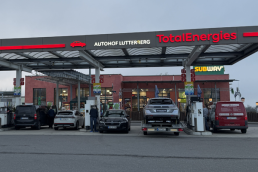
To understand why this matters, you have to appreciate just how dynamic the German fuel pricing market was before the reform. Unlike the United States where station-level price changes are relatively infrequent, often reflecting rack price movements, competitive responses, or weekly demand cycles, German operators were changing prices constantly. We are talking about 20 to 22 individual price adjustments per station, per day, on average. The German federal market transparency body, the MTS-K (operated by the Bundeskartellamt, the Federal Cartel Office), recorded and published every single change in near real-time.
The pattern was systematic. A handful of larger upward moves would cluster in the early morning, pushing prices to daily peaks between 7 and 8 a.m. right as commuters needed to fill up for work. Then, throughout the day, prices would ratchet down in many small incremental steps, bottoming out in the early evening, typically between 7 and 8 p.m. The total intraday swing ran to roughly 13 cents per liter, according to ADAC, Germany’s largest motoring club and the country’s primary source of fuel price consumer intelligence. That’s just under 50 cents per gallon in U.S. term, a meaningful difference that savvy consumers learned to exploit.
The consumer lesson was simple and widely understood. Never fill up in the morning rush, wait until evening. It shaped behavior and it also shaped which gas stations won.
The 12 O’Clock Rule inverts the old logic almost entirely. With price increases restricted to a single noon window, the competitive dynamic shifts. Operators now compete by reducing prices throughout the day to attract volume, then reset margins at noon. The result is a new and very different intraday price curve, one that peaks at 12:00 p.m. and drifts downward from there.
Early data from ADAC’s post-reform monitoring makes the effect concrete. At the noon price reset, E10 gasoline is jumping by an average of around 9 cents per liter, and diesel by roughly 10.5 cents per liter. Those are large, visible, consumer-noticed moves. And crucially, the cheapest moment to fill up is no longer the evening, it is now just before noon, when prices are sitting at their lowest point before the daily reset. ADAC’s first figures put that pre-noon trough at approximately 2.7 cents per liter below the daily average.
Here is where the story gets strategically interesting and where it becomes directly relevant to anyone thinking about how pricing structure and site performance interact.
In the pre-reform era, German industry analysts identified a location pattern that made intuitive sense: stations on the right-hand side of outbound arterial roads, positioned for easy pull-in by evening commuters heading home, had a structural advantage. The cheap evening pricing window coincided with the outbound traffic flow. Right-hand pull-in on an outbound road is easy, safe, and habitual. Those sites benefited.
The 12 O’Clock Rule changes that calculation. If the cheapest moment to fill up is now late morning, the inbound commute window when people are driving into the city for work, then the sites that benefit should be those on the right-hand side of inbound arterials. The logic is clean: cheap prices now align with morning inbound traffic, not evening outbound traffic.
It is important to be precise about the evidence here. The pricing time-shift is empirically confirmed by ADAC data. The resulting location-performance shift is, as of May 2026, a strategically compelling hypothesis, not yet a proven fact. Validating it requires transaction volume data by time of day and road orientation. That data will take months to accumulate. Operators making portfolio decisions should treat the location thesis as a planning assumption, not a proven conclusion.
Why Should U.S Operators Care?
Fair question. The United States does not have a comparable pricing regulation and given the American regulatory tradition around retail fuel markets, it is unlikely to get one anytime soon. So why does this matter for a downstream operator in Tulsa or Tallahassee? For several reasons and they are worth thinking through carefully.
First, the data Germany is now generating is unprecedented.
No major Western fuel market has ever run a controlled experiment like this, a hard reset of intraday pricing structure applied uniformly across thousands of stations, overnight. The resulting natural experiment will tell us things about consumer behavior, competitive response, and site performance that have never been observable before. That data will be studied intensively by academics, regulators, and consultants for years. The insights will travel.
Second, the pressure for pricing transparency reform is not uniquely German.
Consumer advocacy groups in multiple countries, including the United States at the state level, have pushed for various forms of pricing disclosure and anti-gouging regulation. Germany’s experience will be Exhibit A in those debates. If the 12 O’Clock Rule demonstrably helps consumers without destroying operator margins, it will be cited. If it creates unintended distortions, that will be cited too. Either way, U.S. operators benefit from understanding the German experiment before it becomes a policy reference point in domestic discussions.
Third, the location-performance insight is universally applicable.
Every market has an intraday pricing cycle. Every market has motorists who are more or less price-sensitive at different times of day. The German data will, for the first time, allow a rigorous analysis of how a shift in the cheapest-refueling window affects which stations win volume. That analytical framework does not require a German-style regulation to be useful. It can be applied in any market where pricing dynamics differ by time of day, which is to say, every market.
The Questions Worth Watching
Germany’s reform is barely weeks old, the data is thin, and the competitive responses are still forming. Several open questions will determine how the story develops and how useful the German precedent ultimately is for international observers.
Will operators all jump simultaneously at noon?
If every station in a competitive cluster raises prices at 12:00 p.m. on the dot, the consumer-facing effect is amplified – a sharp, synchronized spike that is hard to miss. But if some operators hold back to grab volume at the expense of competitors, the dynamics become more complex. Early indications suggest coordination is strong, but this may evolve as operators test the boundaries.
How steep will the post-noon decline be?
The rate at which prices fall after noon determines how long the afternoon and evening remain competitive windows. If prices drop quickly, consumer behavior may fragment. If they decline slowly, the pre-noon window becomes even more dominant.
Will the location effect show up in the data?
This is the headline question for the industry. Operators with mixed inbound/outbound portfolios are watching their site-level transaction data carefully right now. The first credible analysis comparing inbound vs. outbound performance post-April 2026 will be highly anticipated reading.
The Bottom Line
Germany has done something remarkable in fuel retail. It has taken a market defined by constant micro-pricing chaos and imposed a single, clean structural constraint. The noon rule is simple. Its downstream effects are complex, consequential, and still unfolding.
What we know with confidence: the timing of the cheapest refueling window has shifted from evening to late morning. What remains to be proven: whether that shift materially changes which stations win. What is almost certain: the answers, when they come, will be relevant to fuel retailers everywhere.
The American market operates differently. The U.S. regulatory environment, commuting patterns, station density, and competitive structure differ from Germany in ways that matter. But the fundamental economics of consumer price sensitivity, intraday demand timing, and site location advantage are universal.
Watch Germany. The data coming out of Frankfurt, Munich, and Hamburg over the next twelve months may be the most instructive natural experiment in fuel retail that any of us will see in our careers. The clock, quite literally, is running.
SOURCES & METHODOLOGY
Analysis draws on ADAC Tankstellenreport (multiple issues, including first post-reform data releases April–May 2026); Bundeskartellamt MTS-K published reports; E-Control (Austria) fuel price monitoring publications. All price conversions from cents/liter to cents/gallon use a factor of 3.785.
DISCLOSURE & NOTES
This editorial represents the views of the contributing analysts. It does not constitute investment advice or operational guidance. Post-reform data referenced reflects early observations only; conclusions should be revisited as the dataset matures over the coming months.
MORE FROM VGN
Latest Vision Reports from VGNBROWSE VISION REPORTS

Can AI Help Small Operators? How Favtrip Creates AI Solutions One Problem at a Time
The September SOVG Vision Report explores how a small operator built practical AI tools to catch billing errors, streamline invoice reconciliation, spot trending products, and improve hiring, while offering a clear roadmap for other operators to start small, stay disciplined, and free up time for growth.

Strait Talk: The Outlook for the Global Energy Market
The Outlook for the Global Energy Market The September CLVG Vision Report examines a global energy market reshaped by refining capacity losses rather than crude oversupply. Analysts weigh hurricane risk against record refinery run rates, an uncertain Strait of Hormuz, and unpredictable Chinese demand, while offering strategies for retailers to diversify fuel supply and prepare for volatility.

From Signal to System: How C-Store IT Leaders Are Turning Data Into Operational Intelligence
The CTVG July Vision Report examines how c-store IT leaders can move beyond collecting and connecting data to building trustworthy infrastructure and leveraging AI to turn operational signals into actionable business insights. Topics include semantic layers, data governance, AI prompting best practices, hallucination risks, and real-world retailer experiments already delivering results.
Latest VGN Lens Articles
A Local Problem, and a Local Answer
Illegal tobacco sales often stay hidden in store data until losses are already severe. Operators can build an expected sales benchmark from existing POS data to catch illicit trade intrusion early, then turn that customer loss into a foodservice growth opportunity.

NACS Convenience Summit Europe in Warsaw Poland
Myra Kressner reflects on attending the NACS Convenience Summit Europe in Warsaw, Poland, where networking with VGN members and global retailers, along with store tours across fuel stations, convenience chains, and foodservice concepts, reinforced how customer experience and destination shopping continue to shape convenience retailing worldwide.

Generation Żabka: The Next Wave of Convenience
Lonnie McQuirter recounts a visit to Żabka Group's Warsaw headquarters, examining how the Polish convenience giant built retail media, app-based loyalty, and autonomous Nano stores into new growth engines. McQuirter draws transferable lessons for independent operators, from auditing fixed assets to finding the small, unglamorous gaps in a customer's day worth closing.