Australia’s struggle with illicit tobacco provides important lessons on how to handle illegal trade intrusion as other regions — UK, Europe, and U.S. cities and states — tighten tax policies and restrict tobacco sales. Often, these consumer shifts to illegal alternatives are not immediately obvious to operators.
At the June GCVG meeting, Mert Dünder, head of operational technology at Petrol Ofisi Group, asked which early-warning KPIs signal that illegal competition has arrived. Theo Foukkare, chief executive officer for the Australian Association of Convenience Stores (AACS), provided a well-reasoned list: tobacco volume, items per basket, and that obvious tell, “the customer asking why your pack costs 4x what the shop down the road charges.” But aside from that last admission, the trouble with counting on purchased-based KPIs is timing. In Australia, only about 1 in 10 convenience shoppers buys tobacco, so early shifts to illegal tobacco are diluted in sales records among a majority of shoppers whose baskets don’t change, and are buried under promotions, payday, and weather effects. By the time a basket average visibly drops, the shift will be months old.
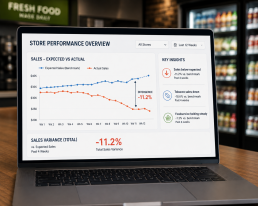
An expected sales line for each store is the more precise instrument to detect this shift, and it finds the intrusion earlier. Take the cluster of stores in your network with similar tobacco sales histories and blend them into a single weighted benchmark. That gives you what this week’s sales should be if local conditions have not changed. National effects like tax increases, advertising campaigns, and seasonal trends hit every store in the benchmark too, so they are already factored in. Then, read the pattern. If tobacco falls below the expected sales line while food and fuel hold theirs, an illicit market is likely intruding. If everything falls together, it is more likely roadworks or a staffing shortage. All of this can be built with data your POS already generates: no new software, no loyalty data, no custom design work.
These early warnings should be catalysts for store reorientation. Rather than viewing a 10% customer loss as a fatal blow, consider it an opportunity to rethink the experience for the remaining 90% of shoppers who never bought tobacco. Retailers already impacted by these shifts have pivoted by repricing and restructuring the categories that tobacco once anchored, centering visits around quality food and coffee. While a great breakfast sandwich is not as addictive as nicotine, it can build a habit of crave-worthy daily visits that no illegal tobacco shop can compete with.
The same data set that spots the shift to illegal tobacco can also measure whether a foodservice transformation is working. Stores that made the change, read against the stores that did not, tell you what to roll out to the rest of the network.
Jesper Østergaard, CEO of Reitan Convenience Denmark A/S, pointed out that his team now approves new sites on business cases that assume zero tobacco. That’s the right posture for what you build next. But the analytical approach that plots an expected sales line from similar stores answers this question for existing stores: where the impact has already hit, how deep does it run, and which stores to act on first.
Read the full Vision Report “Global Lessons on Regulation, Resilience, and Growth Beyond Fuel” to learn more about the illicit tobacco discussion.
Matt Pereira is the Co-Founder and CEO of Seurat Analytics, outside analytics for multi-site retail. Seurat keeps an evidence library of operational moves measured across the stores that ran them, matched to stores like yours, so operators can copy what already worked instead of learning it the hard way.
MORE FROM VGN
Latest Vision Reports from VGNBROWSE VISION REPORTS

Can AI Help Small Operators? How Favtrip Creates AI Solutions One Problem at a Time
The September SOVG Vision Report explores how a small operator built practical AI tools to catch billing errors, streamline invoice reconciliation, spot trending products, and improve hiring, while offering a clear roadmap for other operators to start small, stay disciplined, and free up time for growth.

Strait Talk: The Outlook for the Global Energy Market
The Outlook for the Global Energy Market The September CLVG Vision Report examines a global energy market reshaped by refining capacity losses rather than crude oversupply. Analysts weigh hurricane risk against record refinery run rates, an uncertain Strait of Hormuz, and unpredictable Chinese demand, while offering strategies for retailers to diversify fuel supply and prepare for volatility.

From Signal to System: How C-Store IT Leaders Are Turning Data Into Operational Intelligence
The CTVG July Vision Report examines how c-store IT leaders can move beyond collecting and connecting data to building trustworthy infrastructure and leveraging AI to turn operational signals into actionable business insights. Topics include semantic layers, data governance, AI prompting best practices, hallucination risks, and real-world retailer experiments already delivering results.
Latest VGN Lens Articles

NACS Convenience Summit Europe in Warsaw Poland
Myra Kressner reflects on attending the NACS Convenience Summit Europe in Warsaw, Poland, where networking with VGN members and global retailers, along with store tours across fuel stations, convenience chains, and foodservice concepts, reinforced how customer experience and destination shopping continue to shape convenience retailing worldwide.

Generation Żabka: The Next Wave of Convenience
Lonnie McQuirter recounts a visit to Żabka Group's Warsaw headquarters, examining how the Polish convenience giant built retail media, app-based loyalty, and autonomous Nano stores into new growth engines. McQuirter draws transferable lessons for independent operators, from auditing fixed assets to finding the small, unglamorous gaps in a customer's day worth closing.

EV Arbitrage – Is It for You?
Explores how bidirectional EV batteries could solve the "duck curve," the gap between declining solar production and rising evening electricity demand. Drawing on a discussion with Jose Bueno-Torre of the Center for Community Energy, Strasburger examines electricity arbitrage opportunities for both EV owners and convenience retailers.