If you want to see “full on” retailing, India is the market to visit. India’s retail sector is moving at extraordinary speed and what makes India unique is the coexistence of scale and fragmentation. Everyone is selling everything everywhere. The Indian retail market is expected to double, from $1 trillion to $2 trillion, by 2032. There are over 13 million shops that can be defined as “convenience stores” including roughly 12 million kiranas – small neighborhood shops that meet local day to day needs.

Our study group, a very knowledgable collection of independent retailers from the UK and Ireland led by Scott and Ragini Annan and Pradeep Chechani, visited retailers representing the entire spectrum of Indian non-fuel food retailing. From the “mom and pop” kiranas to the high-end retailers such as Freshpik and Go Fresh, with mid-level retailers and discount stores in between, we saw that Indian retailers excel at defining their customers’ needs and meeting their expectations. We also had the chance to visit the Vashi AMPC wholesale produce market where 12,000-15,000 metric tons of fruit and vegetables arrive on 15,000 trucks – everyday.
Two highlights of the visit were meeting Mr. Kumar Rajagopalan (CEO of the Retail Association of India) and Mr. Damodar Mall (CEO of Grocery Retail at Reliance Industries ): Reliance Retail alone now operates around 19,000 stores, serves 350 million online customers, and generated $39 billion in revenue last year. We also had presentations by Mr. Dipayan Baishya (a business strategist who presented on Quick Commerce), Mr. Sanjay Mishra (Chairman of Cookieman), and Ms. Ritu Jagtiani and Ms. Minal Punjabi (co-founders of My Green Space herbal beauty products). The meetings were very informative in understanding the Indian retail environment.
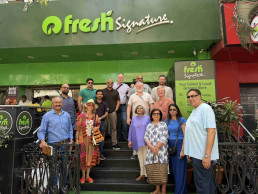
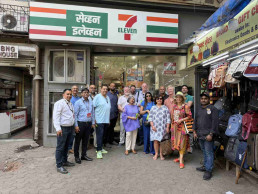

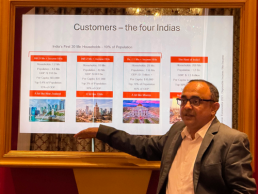
Some of our learnings included:
- There is a huge disparity in India’s economy. 90% of the population (1.2 billion people) earn US$1,200 or less while the top end of the population, 0.4% or 4.8 million people, earn more than US $63,000.
- 98% of the population have 4G cellular data service which means that e-commerce and information are accessible to everyone.
- India has a Maximum Retail Price (“MRP”) on every product except foodservice. The manufacturer sets the MRP, meaning that stores with proprietary products can control their profit margin. As a side note, almost all stores, except the discount stores, sell their products at the MRP meaning that there is not a lot of price competition.
- The challenge for in-store foodservice is the number and variety of street food vendors that offer popular dishes at low prices.
- The low cost of labor (average wage is US$30 per week) allows a service level that cannot be replicated in Europe or the US.
- India has a rising e-retail sector called “Quick Commerce” where items are delivered within 15 minutes from dark stores with little or no delivery fee. The QC market is expected to be $200 billion by 2027 and convenience retailers see it as an existential threat. Legacy retailers like Walmart and Amazon are struggling to keep up.
- In the mid-market to high-end stores, we were told that there are three customers: the person who pays, the person who picks it up, and the person who consumes the product. This a reflection of the fact that almost all households in the middle income and above sectors have servants who do their grocery buying. The reality is that the income earner is not always the purchase decision maker.

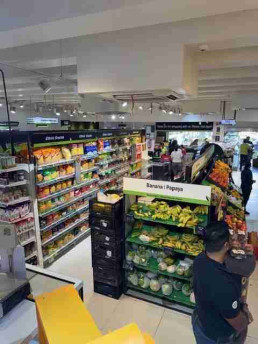
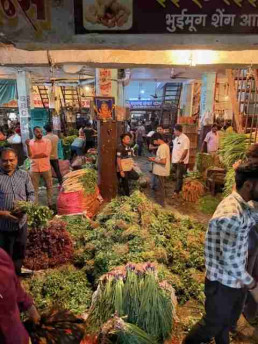
In summary, while there were no hard takeaways to implement, having a better understanding of the Indian market will allow us to be open to new ideas and developments in our own market. The main message is that every retailer needs to understand their customers’ needs and expectations and strive to meet them as fully as possible. Because, if you don’t do it, someone else will.
MORE FROM VGN
Latest Vision Reports from VGNBROWSE VISION REPORTS
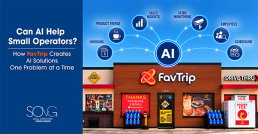
Can AI Help Small Operators? How Favtrip Creates AI Solutions One Problem at a Time
The September SOVG Vision Report explores how a small operator built practical AI tools to catch billing errors, streamline invoice reconciliation, spot trending products, and improve hiring, while offering a clear roadmap for other operators to start small, stay disciplined, and free up time for growth.

Strait Talk: The Outlook for the Global Energy Market
The Outlook for the Global Energy Market The September CLVG Vision Report examines a global energy market reshaped by refining capacity losses rather than crude oversupply. Analysts weigh hurricane risk against record refinery run rates, an uncertain Strait of Hormuz, and unpredictable Chinese demand, while offering strategies for retailers to diversify fuel supply and prepare for volatility.

From Signal to System: How C-Store IT Leaders Are Turning Data Into Operational Intelligence
The CTVG July Vision Report examines how c-store IT leaders can move beyond collecting and connecting data to building trustworthy infrastructure and leveraging AI to turn operational signals into actionable business insights. Topics include semantic layers, data governance, AI prompting best practices, hallucination risks, and real-world retailer experiments already delivering results.
Latest VGN Lens Articles
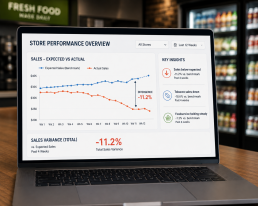
A Local Problem, and a Local Answer
Illegal tobacco sales often stay hidden in store data until losses are already severe. Operators can build an expected sales benchmark from existing POS data to catch illicit trade intrusion early, then turn that customer loss into a foodservice growth opportunity.

NACS Convenience Summit Europe in Warsaw Poland
Myra Kressner reflects on attending the NACS Convenience Summit Europe in Warsaw, Poland, where networking with VGN members and global retailers, along with store tours across fuel stations, convenience chains, and foodservice concepts, reinforced how customer experience and destination shopping continue to shape convenience retailing worldwide.
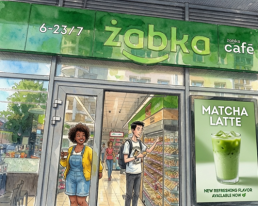
Generation Żabka: The Next Wave of Convenience
Lonnie McQuirter recounts a visit to Żabka Group's Warsaw headquarters, examining how the Polish convenience giant built retail media, app-based loyalty, and autonomous Nano stores into new growth engines. McQuirter draws transferable lessons for independent operators, from auditing fixed assets to finding the small, unglamorous gaps in a customer's day worth closing.