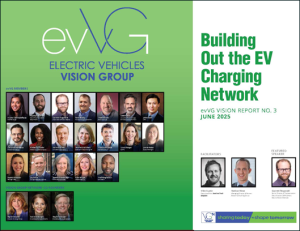
The Electric Vehicles Vision Group (evVG) has released its latest Vision Report, “Charging Ahead: Building Out the EV Charging Network,” examining the critical challenges and opportunities in developing America’s electric vehicle charging infrastructure. The report explores infrastructure development, consumer behavior, technology innovations, and regulatory frameworks that will shape the future of U.S. EV charging.
The latest evVG virtual quarterly meeting was held on April 30, 2025, and was facilitated by Mike Austin, executive editor of Road and Track Magazine, and Nathan Niese, managing director & partner, Boston Consulting Group. The meeting featured a presentation by evVG Member Garrett Fitzgerald, senior director of transportation electrification at SEPA (Smart Electric Power Alliance).
Key takeaways in the report include:
- The EV Charging Paradigm Shift: The report highlights how EV charging fundamentally differs from traditional fueling, with most charging occurring at private locations rather than public stations. Fitzgerald emphasized: “charging integrates into your life rather than the other way around. You have to integrate into where the fueling infrastructure is.”
- Infrastructure and Grid Challenges: Utilities face unprecedented challenges from rapidly growing EV loads that require significant infrastructure planning and investment. As Fitzgerald explained: “We’re really dealing with a mismatch in the planning and building cycle of what loads used to look like and what loads are looking like now.”
- Current Infrastructure Development: While DC fast charging deployment is progressing, reliability remains crucial, with some systems experiencing failure rates up to 35% of the time. Gabe Klein, former executive director of the U.S. Joint Office of Energy & Transportation, noted: “I think we put so much pressure on DC fast chargers. Some rightfully so; Some maybe we’ve over indexed. and I will admit at the federal level, we didn’t put enough emphasis on low-speed public charging, city streets, municipal garages, so on and so forth. We need a balanced system.”
- Demand Charges and Economic Viability: The economics of EV charging remain challenging due to demand charges that can create unpredictable costs for operators. Fitzgerald observed: “The level two at the grocery store that is free and there’s zero motivation to fix it once you’ve got that grant to install it. So we think about how do we sustain those beyond just the folks who took the grant, got it in there, and then it just gets dust.”
- Consumer Misconceptions and Education Gaps: Despite high satisfaction rates among EV owners, widespread misconceptions persist about EV functionality and daily use. Darren Palmer, Global VP Electric Vehicle Programs at Ford Motor Company, stated: “[Consumers are] not realizing the benefit because they focus on this trip and [what] won’t work on that trip. And, they also don’t really know that for those trips, say 500 miles, you stop for 20 minutes and you have to stop anyway for comfort, get a coffee and a doughnut. By the time you’re out, it’s charged.”
- The Need for Public Education: The group emphasized the critical need for comprehensive education campaigns to address misconceptions about EV ownership. Sophia Schuster, Policy Principal at Michigan EIBC shared: “ I just wanted to kind of plus up the whole education component because a lot of Americans still really depend on the dealers to provide accurate information, and if the salespeople can’t do that, we have a huge problem.”
To read the full Vision Report for this meeting click the Get Report button:
Get Report
To read the full transcript for this meeting and to access any other meeting components click the button below.
Read Transcript