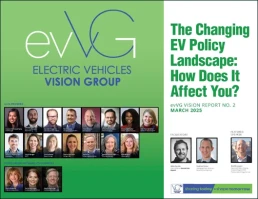
The Electric Vehicles Vision Group (evVG) has released its second Vision Report, “The Changing EV Policy Landscape: How Does It Affect You?” exploring the evolving U.S. policy and regulatory landscape, market demand, infrastructure and development. While challenges abound, there is continued momentum toward electrification. The role of AI, strategic retail investments, and future-proofed infrastructure will be critical in shaping the next phase of the EV market.
The evVG virtual quarterly meeting was held on February 5, 2025, and was facilitated by Mike Austin, executive editor at Road and Track Magazine, and Nathan Niese, managing director and partner, Boston Consulting Group. The meeting featured a presentation by Karl Doenges, executive director, Charging Analytics Program (CAP), Transportation Energy Institute (TEI).
Key takeaways in the report include:
- The Future of Electric Vehicles and Charging: Presenter Karl Doenges suggested the transportation sector’s transition to EVs will be gradual, with ICE vehicles remaining dominant through 2050 despite decarbonization initiatives. Retailers face challenges from declining fuel demand and can find opportunities with increased in-store spending by EV owners during longer charging stops. Doenges explored directions the new Trump Administration may go with energy policy and its impact on EV policies and funding. He commented: “We are going to see a change in rhetoric from the Biden administration to the Trump administration. We do believe it will change the pace of the EV growth, but it will not stop it.”
- Market Growth and Consumer Adoption: The group discussed EV charging and the role of convenience stores, noting that while EV customers tend to spend more per visit, there are fewer of them compared to gasoline customers. Site layout and additional options such as car washes are important to attract EV drivers as well (dirt particles can affect computer functionality). Tom Healey, VP of facilities for Nouria Energy Corporation, said: “There’s tension between taking up parking spaces for EVs, planning more towards the future, versus our current customer base and being able to accommodate them at peak times for access to the convenience store and convenient parking.”
- Economics of EV Charging and Retail Locations: The group also discussed shifting EV charging patterns, with members predicting a move toward “top-off” charging behaviors, prompting retailers to focus on inside sales. Facilitator Mike Austin suggested, “When EVs first came out, you had 50 kilowatt chargers or maybe you had level 2 chargers. Now we have higher powers and the plugs –we’re in the midst of a plug changeover –and then even the way that people are charging is going to change or adapt. I think that when you have higher range, you might not be staying for as long just because you only need a few miles to get home or get to your destination.”
- EV Charging Infrastructure and Development: EV charging infrastructure development was also a hot topic, highlighting the cost advantages of incorporating charging during initial construction versus retrofitting, the benefits of standardizing connectors, and concerns about potential market competition between utility-owned and private charging stations. Jay Smith, executive director for Charge Ahead Partnership, said, “Those on the retailer side, what I hear is they’re looking for a competitive environment, they’re used to competition. They’re used to gas stations across from each other and they compete with amenities and who has the cleaner bathroom and who has the better price of gas by a penny. They’re used to that competition, but they’re hesitant to invest and staying away from investment where they can’t have that level playing field.”