At our May evVG meeting, Jose Bueno-Torre, the executive director of the Center for Community Energy and evVG member, talked about the “duck curve.” In a nutshell, the duck curve happens when solar energy production declines at sunset and electricity demand goes up as people return home and turn on their electrical gadgets. The rub is that electricity must be created at the time of demand and the production facility has to be large enough to meet the maximum demand point whenever it is created. As demand goes up, larger production facilities – whether they are coal fired, natural gas, or biomass – and their infrastructure have to be ready to go online, even if it only for an hour a day.
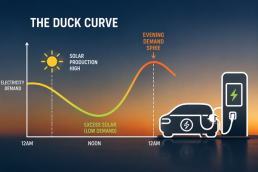
A solution to the duck curve is bi-directional batteries. These devices can accept electrons from the grid but can also put them back into the grid as well. Think of it as using your EV car battery as a back-up battery for your home (remember the Ford F-150 Lightning advertisements? But that is another article). Doing this is called Vehicle to Grid (V2G) or Vehicle to Home (V2H). This is one option to create a Virtual Power Plant (VPP) – using software to coordinate decentralized power sources to bring electrons back into the grid when demand spikes
Jose’s central thesis is to use decentralized solar panels (on top of parking lots or offices) to charge bi-directional EVs during the day when electricity is plentiful and cheap. Drivers would then return home with their EVs, plug them in, and the utility would use the car’s batteries (with permission) to cover the duck curve demand spike – never going below a 30% charge on the vehicle. The car owner would recharge the car the following day at the office. The bottom line is that by using VPP to meet demand spikes, utilities do not have to increase their production capacity or necessarily add to the grid infrastrcture.
It is a very cool idea, and Jose explains it further (and better) in the evVG Vision Report “How Bidirectional EVs Could Reshape American Energy“.
The conversation brought up the question of what kind of incentives it would take to get an EV owner to participate in such a program. Jose suggested a hypothetical situation where the EV owner would pay $0.05/kwh to charge his car at the office but sell the electrons to the grid for $0.10/kwh when the EV was at the house. The owner would literally be making money while she slept – electricity arbitrage! (Just to be clear, this would take some technology upgrades and regulatory innovations –andcustomers making money from selling electricity to the grid is prohibited in some states.)
The evVG group then briefly touched on a more nuanced hypothetical. Assuming that the technology and regulatory issues mentioned above are met, could a retailer eventually buy and sell electricity at their location? If the retailer installed a bi-directional “charger” and sufficient battery storage at their site, he could offer to buy our office worker’s electrons for $0.08/kwh if the utility isn’t buying extra power or for $0.12 if they are (or maybe even $0.05 plus a free coffee!). The retailer can then either resell the electrons (for $0.10/kwh or $0.14/kwh) or use the electricity to run their store. After labor, electricity is one of the larger costs in operating a site and usage is going up. There may be a way to reduce store operating costs through electricity arbitrage.
Other options: if the current electric utility rate in most states remain in place, a retailer could use electrons bought “off grid” to avoid demand charges caused by exceeding certain thresholds. If electrons become a commodity, could a retailer put excess electrons into the grid and take them out at another store that needs extra power? The retailer could sell the excess electrons back to the grid to reduce the duck curve – just like the folks at home. Or retail companies might be able to negotiate long term supply contracts with utilities or other businesses to turn “electron harvesting” into a profit center.
Some of this might happen, and some of it may not. The important thing to note is that creative thinking was sparked (see what I did there?) by the evVG conversation. This is the reason the Vision Group Network exists, to talk about solutions and opportunities and then share them with others.
Read the full Vision Report “How Bidirectional EVs Could Reshape American Energy” to learn more.
MORE FROM VGN
Latest Vision Reports from VGNBROWSE VISION REPORTS

Can AI Help Small Operators? How Favtrip Creates AI Solutions One Problem at a Time
The September SOVG Vision Report explores how a small operator built practical AI tools to catch billing errors, streamline invoice reconciliation, spot trending products, and improve hiring, while offering a clear roadmap for other operators to start small, stay disciplined, and free up time for growth.

Strait Talk: The Outlook for the Global Energy Market
The Outlook for the Global Energy Market The September CLVG Vision Report examines a global energy market reshaped by refining capacity losses rather than crude oversupply. Analysts weigh hurricane risk against record refinery run rates, an uncertain Strait of Hormuz, and unpredictable Chinese demand, while offering strategies for retailers to diversify fuel supply and prepare for volatility.

From Signal to System: How C-Store IT Leaders Are Turning Data Into Operational Intelligence
The CTVG July Vision Report examines how c-store IT leaders can move beyond collecting and connecting data to building trustworthy infrastructure and leveraging AI to turn operational signals into actionable business insights. Topics include semantic layers, data governance, AI prompting best practices, hallucination risks, and real-world retailer experiments already delivering results.
Latest VGN Lens Articles
A Local Problem, and a Local Answer
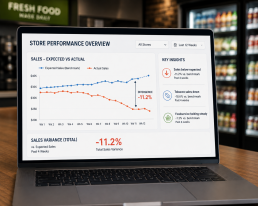
Illegal tobacco sales often stay hidden in store data until losses are already severe. Operators can build an expected sales benchmark from existing POS data to catch illicit trade intrusion early, then turn that customer loss into a foodservice growth opportunity.

NACS Convenience Summit Europe in Warsaw Poland
Myra Kressner reflects on attending the NACS Convenience Summit Europe in Warsaw, Poland, where networking with VGN members and global retailers, along with store tours across fuel stations, convenience chains, and foodservice concepts, reinforced how customer experience and destination shopping continue to shape convenience retailing worldwide.

Generation Żabka: The Next Wave of Convenience
Lonnie McQuirter recounts a visit to Żabka Group's Warsaw headquarters, examining how the Polish convenience giant built retail media, app-based loyalty, and autonomous Nano stores into new growth engines. McQuirter draws transferable lessons for independent operators, from auditing fixed assets to finding the small, unglamorous gaps in a customer's day worth closing.